
The AI Skills Gap Is Wider Than Most Organizations Realize
There is a quiet crisis building inside many of today's largest organizations, and most HR leaders have no idea it's happening. Employees say they know how to work with artificial intelligence. They've completed the courses, checked the boxes, and attested to their proficiency. But when their skills are actually tested, a very different picture emerges. According to Workera's 2026 AI Skills Enterprise Benchmark Report, based on 88,753 individual assessments, verified AI skills lag significantly behind what employees self-report — and that gap is creating measurable business risk.
The findings arrive at a critical moment. Enterprises across every industry are accelerating AI adoption, deploying automated workflows, and investing heavily in AI-assisted decision-making. If the workforce is not genuinely ready to support those systems, those investments will underperform. The question is no longer whether companies are investing in AI — it's whether their people can actually use it.
Self-Reported Proficiency Is Not the Same as Verified Skill
For years, HR teams have relied on self-attestation and course completion data to measure workforce readiness. An employee finishes an online AI course, marks the skill as acquired, and the learning management system logs a green checkmark. This approach is convenient, scalable, and nearly useless as a measure of real capability.
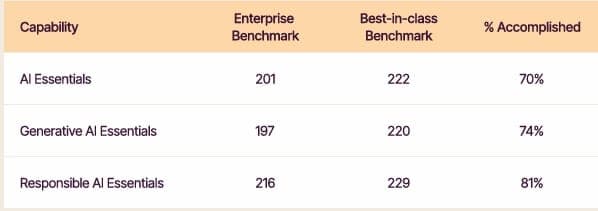
Workera's benchmark data makes the problem concrete. The platform uses a 300-point scoring scale to assess verified competence. A score above 200 indicates that an employee can design and build AI solutions — not simply recognize concepts or recall definitions. When the assessment results are compared to what employees believe about their own abilities, the divergence is stark. Workers routinely overestimate their technical depth, particularly in areas that require hands-on application rather than conceptual familiarity.
This is not a reflection of employee dishonesty. It is a structural problem with how skills have historically been measured. Completion of a training module signals exposure, not mastery. Organizations that have built their AI capability roadmaps on self-reported data are essentially planning on a foundation of assumptions.
Where Employees Are Strongest — and Where They Fall Short
The benchmark report reveals a clear pattern in where enterprise employees perform well and where they struggle. Skills with a low technical barrier show the strongest verified scores. The leading categories include:
- Data Storytelling Essentials — communicating insights derived from data clearly and persuasively
- AI and Data Communication — explaining AI concepts and outputs to non-technical stakeholders
- Responsible AI Essentials — understanding ethical frameworks, bias, and governance principles
These are genuinely valuable skills, and strong scores here reflect real progress in AI literacy across the workforce. However, they are also the areas where conceptual knowledge, rather than technical execution, drives performance. Employees can talk about responsible AI without being able to build an AI system. They can communicate data stories without being able to model the data themselves.
The weakest scores emerge precisely where technical depth is required. Deep Learning Fundamentals, arguably the backbone of modern AI development, averaged just 142 out of 300 across enterprise employees. That score places most workers firmly in the awareness range — they know the term exists, but they cannot apply the principles. Agentic AI Fluency and Agentic AI Engineering both averaged 179, landing in the developing range. Employees in this category can discuss agentic AI concepts but are not capable of deploying or managing agentic systems effectively.
Why Agentic AI Readiness Is the Most Urgent Problem
Of all the skill gaps the report identifies, the agentic AI gap may carry the greatest near-term consequence. Agentic AI refers to systems capable of planning and executing multi-step tasks with limited human oversight. These are not passive tools that answer questions — they are autonomous agents that take actions, make decisions in sequence, and interact with external systems on behalf of users.
Enterprises are deploying agentic systems right now. They are being embedded into customer service operations, software development pipelines, financial analysis workflows, and supply chain management. The expectation is that human employees will work alongside these agents, oversee their outputs, intervene when something goes wrong, and configure them for new tasks. Yet the benchmark data suggests that most employees do not have the verified skills to do any of this effectively.
A workforce that can describe what an AI agent is but cannot actually operate, audit, or redirect one creates a specific kind of operational risk. Errors go undetected. Automation expands in directions no one intended. The promise of AI efficiency is undermined by a skills floor that was never properly measured.
The Concentration Risk HR Leaders Are Overlooking
Beyond the average skill scores, the report surfaces a second concern that receives less attention: concentration risk. In many organizations, advanced AI capability is not evenly distributed — it is held by a small number of individuals. When deep expertise sits with only a handful of employees, that knowledge is fragile. A departure, a restructuring, or even a team reassignment can strip an organization of the very capacity it thought it had built.
HR leaders who rely on aggregate training completion rates will not see this concentration until it creates a crisis. Verified assessments, by contrast, reveal exactly where expertise is clustered and where it is absent — allowing organizations to make deliberate decisions about hiring, upskilling, and knowledge transfer before a single resignation exposes the gap.
What Organizations That Are Pulling Ahead Are Doing Differently
The benchmark report's most actionable insight is also its clearest: organizations that are ahead on AI capability measured first. They did not assume that training participation equaled skill acquisition. They introduced verified assessments, mapped real competencies against strategic AI priorities, and used that data to direct learning investments precisely where they were needed.
This does not require abandoning existing learning infrastructure. It requires augmenting it with measurement. Course completion data still has value for tracking exposure and engagement. But it needs to be paired with verified assessments that distinguish between employees who recognize an AI concept and those who can act on it.
A New Standard for AI Workforce Readiness
The gap between self-reported and verified AI skills is not a minor calibration issue — it is a strategic liability. As AI systems grow more autonomous, more integrated, and more consequential, the cost of misreading workforce readiness will grow with them. HR leaders who continue to rely on self-attestation data are making high-stakes decisions on low-quality information.
The 2026 benchmark data from Workera offers a clearer path: measure what employees can actually do, identify where the real gaps are, and build AI capability strategies on verified evidence rather than optimistic assumptions. The organizations that close the gap between perceived and real AI skills will not just deploy AI more effectively — they will be the ones still leading when the next wave of automation arrives.