
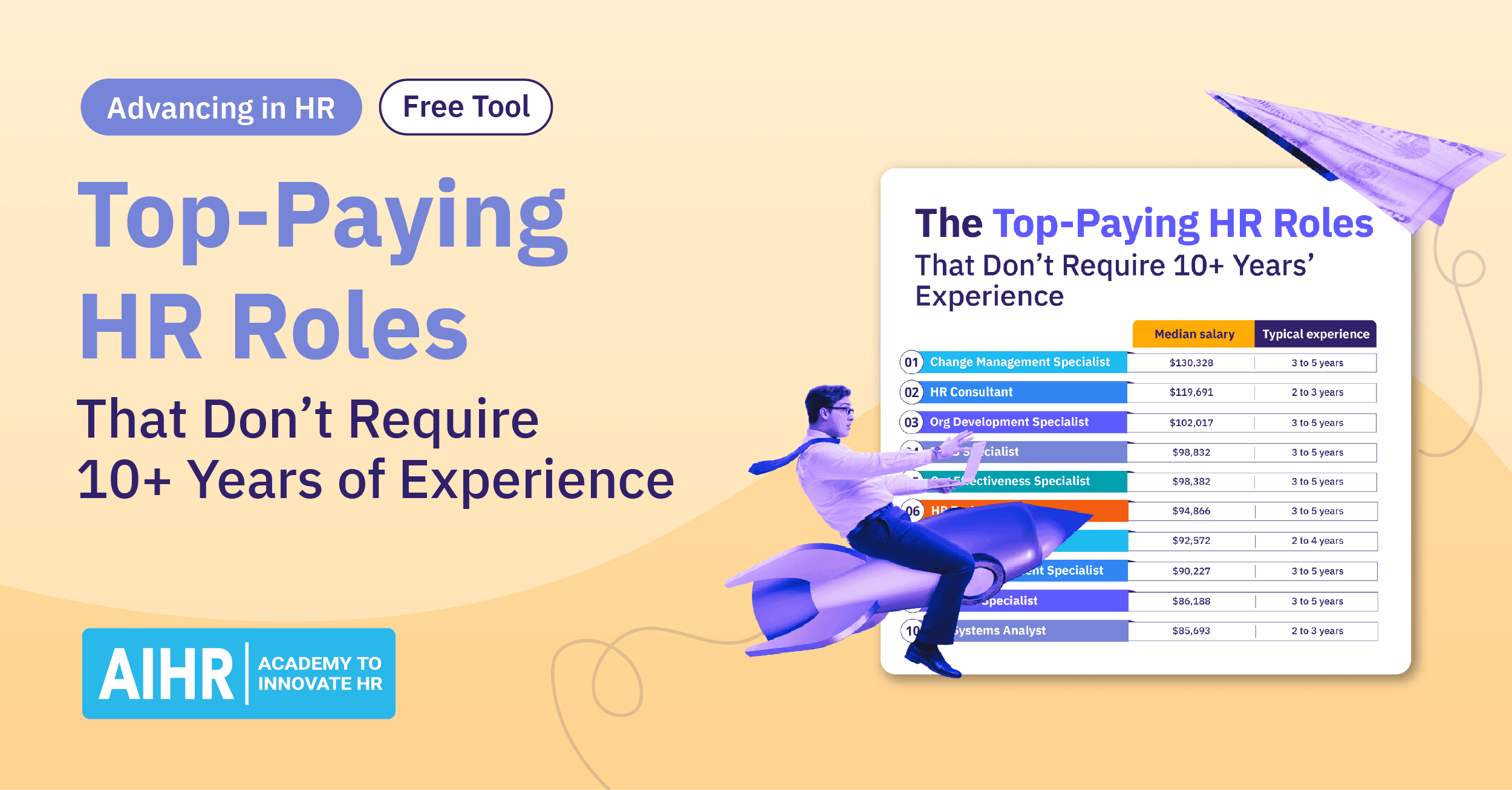
You Don't Need a Decade of Experience to Earn Big in HR
One of the most persistent myths in human resources is that serious salary growth only comes after 10 or more years of grinding through generalist roles. The reality in today's job market is very different. A growing number of specialist HR positions offer strong, competitive compensation well within the three-to-five-year mark — provided you focus your skills in the right areas.
Based on data from AIHR's Career Map salary insights, powered by Revelio Labs, and broader HR career outlook research, we've identified ten high-paying HR roles that are both in demand and accessible to professionals who are still building their careers. Whether you're just a few years in or considering a pivot within HR, these roles represent some of the smartest bets you can make for your professional future.
10 Top-Paying HR Roles by Median Salary
Each of the roles below sits at the intersection of employer demand and strong compensation. They reward specialized knowledge over raw tenure, which means upskilling strategically can fast-track your earnings far sooner than a traditional career ladder would allow.
1. Change Management Specialist — $130,328
The highest median salary on this list belongs to the Change Management Specialist, and it's not hard to see why. As organizations continuously restructure, adopt new technologies, and respond to market disruption, the ability to guide people through transformation has become a premium skill. Change Management Specialists design and execute strategies that help employees adapt to new processes, systems, or organizational structures. Strong communication, stakeholder management, and psychology of change knowledge are central to this role. Certifications like Prosci or ACMP can meaningfully accelerate your path into this position without needing decades of experience.
2. HR Consultant
HR Consultants work either independently or within consulting firms, advising organizations on workforce strategy, compliance, talent management, and HR process improvement. Because they are paid for expertise rather than organizational hierarchy, consultants can command high day rates or project fees relatively early in their careers. Depth in a specific niche — such as compensation benchmarking, HR technology implementation, or labor relations — is far more valuable than broad general experience when building a consulting practice or joining a firm.
3. Organizational Development Specialist
Organizational Development (OD) Specialists focus on improving business performance through people. Their work spans leadership development, team effectiveness, culture design, and organizational design. This role is especially well-compensated because it requires both analytical thinking and interpersonal influence — a rare combination. Those with backgrounds in industrial-organizational psychology or business psychology often find a natural home here, and postgraduate credentials in OD can substitute for years of experience when breaking into the field.
4. DEIB Specialist
Diversity, Equity, Inclusion, and Belonging (DEIB) has evolved from a corporate checkbox into a strategic function. DEIB Specialists develop programs, measure inclusion metrics, advise leadership on equity gaps, and embed inclusive practices across the employee lifecycle. Demand for this role has grown substantially, and organizations are willing to pay competitively for practitioners who can translate DEIB principles into measurable business outcomes. Passion for the subject matter combined with solid project management and data literacy can open doors quickly.
5. Organizational Effectiveness Specialist
While similar to OD, Organizational Effectiveness Specialists tend to focus more narrowly on performance outcomes — identifying bottlenecks in how the organization operates and designing solutions to remove them. They often work closely with senior leadership and use data-driven frameworks to evaluate team structures, workflows, and capability gaps. The analytical rigor required makes this role a strong fit for HR professionals who enjoy working with data and translating findings into strategic recommendations.
6. HR Technologist
The rise of HR technology platforms — from applicant tracking systems to AI-powered performance tools — has created enormous demand for HR professionals who actually understand the technology stack. HR Technologists bridge the gap between HR strategy and digital systems. They manage platform implementations, optimize system usage, and advise on technology roadmaps. As HR tech spending continues to grow, professionals who can fluently navigate tools like Workday, SAP SuccessFactors, or Oracle HCM are increasingly well-compensated, even at relatively junior levels.
7. HR Analyst
People analytics has moved from a niche function to a core HR capability. HR Analysts collect, clean, and interpret workforce data to inform decisions on hiring, retention, compensation, and employee engagement. Proficiency in tools like Excel, SQL, Power BI, or Python can make an HR Analyst highly competitive in the market. This is one of the clearest examples of a role where technical skill outweighs years served — a strong analytical portfolio can command a premium salary even early in your career.
8. Talent Management Specialist
Talent Management Specialists oversee the systems and strategies that attract, develop, and retain top performers. Their work touches succession planning, high-potential programs, performance management design, and career pathing frameworks. This role sits close enough to business strategy that it commands above-average pay, and professionals who demonstrate commercial awareness alongside HR expertise tend to progress and earn quickly.
9. AI in HR Specialist
Perhaps the most forward-looking role on this list, the AI in HR Specialist is an emerging position focused on evaluating, implementing, and governing the use of artificial intelligence within HR functions. From AI-driven recruitment tools to predictive attrition models, this role requires a blend of technical literacy and HR domain knowledge. Given how rapidly AI is reshaping the workplace, demand for this expertise is accelerating fast — and because it's a new specialization, even professionals with limited years of experience can establish themselves as credible experts by staying ahead of the curve.
10. HR Systems Analyst
HR Systems Analysts are the operational backbone of HR technology. They manage data integrity, configure HR information systems, troubleshoot issues, and support end users across the business. While the role is more technical and less strategic than an HR Technologist, it still commands a solid salary and offers a clear growth path toward more senior digital HR roles. For professionals comfortable with systems thinking and process documentation, this is an accessible, well-paying entry point into the digital HR space.
How to Choose the Best High-Paying HR Role for You
With ten strong options on the table, narrowing your focus comes down to a few key questions. First, consider where your existing strengths lie — are you more analytical, strategic, interpersonal, or technical? Roles like HR Analyst and HR Systems Analyst reward data fluency, while Change Management and OD Specialist roles lean heavily on facilitation and influence skills.
Second, think about the industries or types of organizations you want to work in. Some roles, like HR Consultant and AI in HR Specialist, tend to thrive in fast-moving, technology-forward environments. Others, like DEIB Specialist and Talent Management Specialist, are in demand across virtually every sector.
Finally, invest in targeted credentials. Many of these roles have recognized certifications or postgraduate pathways that signal expertise to employers independent of your years of experience. In a field where specialization increasingly commands a premium, knowing which skills to build — and proving you've built them — is the clearest route to top-tier compensation without waiting a decade to get there.
- Change Management: Prosci or ACMP certification accelerates entry.
- People Analytics: Data tools like SQL, Power BI, or Python are high-value differentiators.
- HR Technology: Platform-specific certifications (Workday, SAP) significantly boost earning power.
- AI in HR: Staying current with AI tools and publishing thought leadership can establish authority early.
- OD and Effectiveness: Postgraduate study in organizational psychology or business psychology provides strong credentials.
The message from the data is clear: in today's HR landscape, what you know and what you can do matters far more than how long you've been doing it. Specializing thoughtfully and upskilling deliberately can put six-figure HR salaries within reach well before the ten-year mark.