
The Growing Complexity of Talent Acquisition in 2025
Talent acquisition has never been more paradoxical. On one side, employers across industries report persistent talent shortages and unfilled roles. On the other, job seekers report difficulty landing positions despite strong qualifications. This disconnect reveals a fundamental truth: the traditional hiring model is broken, and talent acquisition (TA) leaders are the ones who must fix it.
Technological acceleration, the rapid rise of artificial intelligence, shifting workforce demographics, and evolving candidate expectations have collectively redefined what effective recruiting looks like. What worked five years ago is already obsolete in many sectors. TA leaders who fail to adapt risk falling further behind in an already competitive talent market.
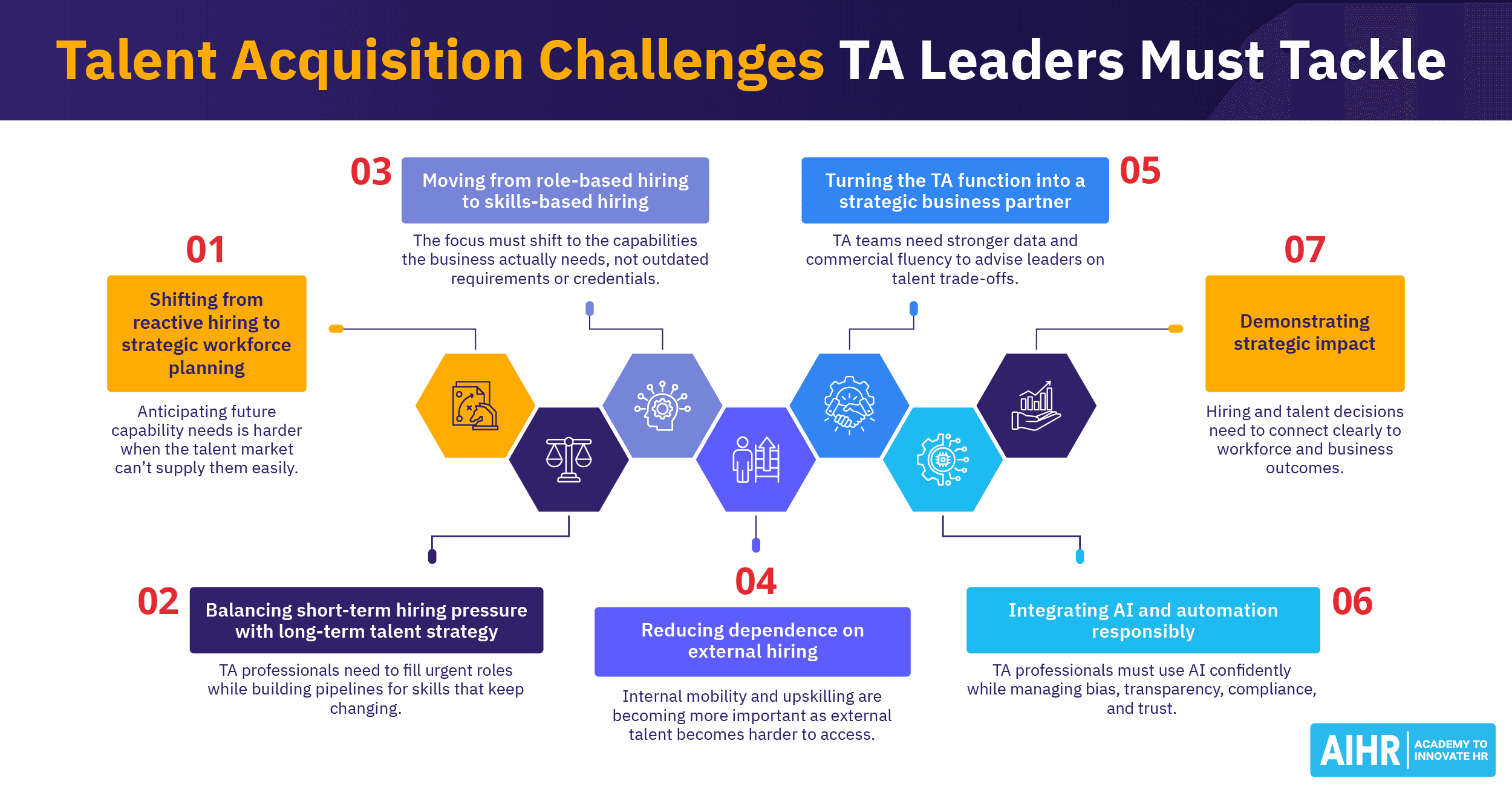
This article breaks down the seven most critical talent acquisition challenges facing TA leaders right now, examines the current state of the field, and offers strategic solutions designed to move recruiting from reactive to truly strategic.
The Current State of Talent Acquisition
The talent acquisition landscape has shifted dramatically over the past several years. The post-pandemic workforce reshuffling, the explosion of remote and hybrid work, and the rapid integration of AI into business operations have all fundamentally changed what skills organizations need — and how quickly those needs evolve.
Traditional recruiting pipelines were designed for a more stable skills environment. Today, technical skills can become obsolete within two to three years, and entirely new roles emerge with little warning. This creates a structural mismatch between the speed at which organizations identify talent needs and the speed at which the market changes around them.
Additionally, geographic concentration of highly specialized talent — particularly in technology and data science — means that organizations competing for the same narrow pool of candidates often rely on the same outdated methods to attract them. The result is high recruitment costs, long time-to-fill rates, and a growing frustration on both sides of the hiring equation.
7 Key Talent Acquisition Challenges TA Leaders Must Overcome
1. Shifting from Reactive Hiring to Strategic Workforce Planning
One of the most persistent challenges in talent acquisition is the tendency to hire reactively — filling roles only after they become vacant or urgent. Strategic workforce planning requires TA leaders to anticipate future skills needs, align hiring timelines with business growth projections, and build proactive talent pipelines before demand spikes. Without this shift, organizations will always be playing catch-up in a fast-moving market.
2. Moving from Role-Based to Skills-Based Hiring
Traditional job descriptions built around rigid role definitions and degree requirements are increasingly screening out qualified candidates. Skills-based hiring — where the focus shifts to demonstrated competencies rather than credentials — opens the talent pool significantly. TA leaders must champion the internal culture change needed to make hiring managers comfortable evaluating candidates on transferable skills rather than conventional career paths.
3. Integrating AI Responsibly into the Recruiting Process
Artificial intelligence is transforming talent acquisition in profound ways, from resume screening and candidate matching to interview scheduling and predictive analytics. However, AI adoption carries real risks, including algorithmic bias and the potential to exclude qualified candidates at scale. TA leaders must implement AI tools thoughtfully, with regular audits for fairness, transparency about their use, and a commitment to human oversight at critical decision points.
4. Addressing Geographic Talent Concentration
High-demand technical talent is often clustered in major metropolitan areas or specific regions, creating fierce local competition and significant compensation inflation. TA leaders must develop strategies to either attract talent remotely, build employer brand in secondary markets, or invest in internal upskilling programs that reduce dependency on external hiring for specialized roles.
5. Improving Candidate Experience at Every Touchpoint
Candidate expectations have risen sharply. Today's job seekers evaluate organizations as carefully as organizations evaluate them. A slow application process, lack of communication, or impersonal interview experience can cost a company top talent before an offer is even extended. TA leaders must audit every touchpoint in the candidate journey and invest in process improvements that signal respect, transparency, and organizational culture.
6. Reducing Bias in Screening and Selection
Unconscious bias remains one of the most damaging and underacknowledged forces in hiring. Traditional screening methods — particularly those relying on resume review or unstructured interviews — are highly susceptible to bias. TA leaders must implement structured interviews, standardized evaluation rubrics, diverse hiring panels, and, where appropriate, blind screening technologies to ensure that qualified candidates are not excluded based on irrelevant factors.
7. Building a Compelling Employer Brand in a Crowded Market
In a market where candidates have access to employer reviews, salary benchmarks, and peer recommendations at their fingertips, employer brand has become a core recruiting asset. TA leaders who do not actively manage and invest in their organization's employer brand will find it increasingly difficult to attract passive candidates and convert interested applicants. This requires close collaboration with marketing, HR communications, and executive leadership to tell an authentic and compelling story about what it means to work at the organization.
Strategic Solutions to Common Talent Acquisition Challenges
Solving these challenges requires more than tactical fixes. TA leaders need a structural approach that addresses both the symptoms and root causes of recruiting friction.
- Invest in workforce planning infrastructure. Partner with business leaders to map anticipated skills gaps 12 to 24 months out, enabling proactive sourcing and pipeline building rather than emergency hiring.
- Redesign job architecture around skills. Work with HR business partners to audit job descriptions, remove unnecessary degree requirements, and define roles by the competencies they actually require.
- Establish an AI governance framework. Before deploying any AI-powered recruiting tool, create a clear policy on data use, bias auditing, and candidate notification. Responsible AI use builds both internal trust and candidate confidence.
- Expand sourcing strategies geographically. Embrace remote-first or hybrid models where feasible, partner with universities in non-traditional markets, and build talent communities in underutilized talent pools.
- Treat candidate experience as a brand investment. Map the full candidate journey and identify points of friction. Implement regular communication protocols, faster feedback loops, and post-process surveys to continuously improve the experience.
- Standardize and structure selection processes. Replace ad hoc interviews with structured formats, use validated assessments where appropriate, and train all hiring managers on recognizing and mitigating bias.
- Build employer brand as a long-term strategic asset. Develop authentic employee value propositions (EVPs) grounded in real workforce data and employee feedback, and invest in channels — social media, review platforms, events — that reach passive candidates.
The Bottom Line for TA Leaders
The talent acquisition challenges of 2025 are not temporary disruptions — they are structural shifts that demand a fundamentally different approach to how organizations find, attract, and retain talent. TA leaders who move beyond reactive hiring, embrace skills-based thinking, leverage AI responsibly, and invest in candidate experience will be best positioned to build the workforces their organizations need to compete and grow.
The gap between organizations that treat talent acquisition as a strategic function and those that treat it as an administrative process is widening. For TA leaders, the opportunity — and the urgency — to bridge that gap has never been greater.