
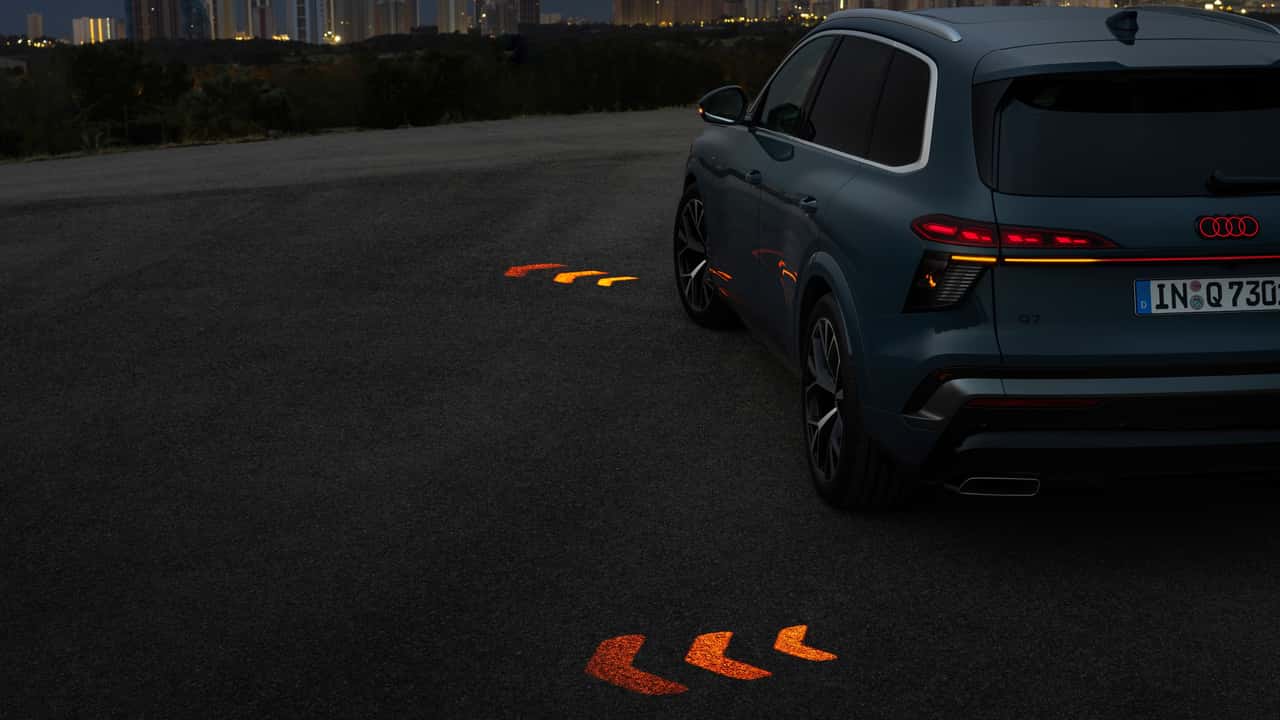
The New Audi Q7 Is Redefining What Headlights Can Do
When most drivers think about automotive innovation, they picture electric powertrains, autonomous driving systems, or cutting-edge infotainment. Rarely does anyone stop to think about headlights. But Audi has long understood that lighting is far more than a visibility tool — it is a communication system, a safety feature, and increasingly, a canvas for engineering artistry. With the latest iteration of the Audi Q7, the German automaker has taken another bold step forward by projecting turn signals directly onto the road surface, signaling a new era in how vehicles interact with the world around them.
What Exactly Does "Road-Projected Turn Signals" Mean?
Traditional turn signals blink on the corners of a vehicle, alerting other drivers and pedestrians that a lane change or turn is imminent. They work, but they have clear limitations — they are only visible from certain angles, and in bright daylight or cluttered urban environments, they can be easy to miss. The new Audi Q7 changes the equation entirely.
Using its advanced Digital Matrix LED headlight system, the Q7 can project animated turn signal indicators directly onto the road surface in front of the vehicle. This means that when you activate your left or right blinker, a dynamic light pattern appears on the ground, clearly communicating your intentions to pedestrians, cyclists, and other road users who might not be in a direct sightline of your traditional indicators. It is a simple concept with profound implications for road safety and driver communication.
The Technology Behind the Innovation
Audi's Digital Matrix LED technology is the backbone of this impressive feature. Unlike conventional LED headlights that operate as a single unit, the Digital Matrix LED system uses millions of micromirrors — similar in concept to the DMD chips found in digital projectors — to create precise, programmable light patterns. Each micromirror can be individually controlled, giving the system an extraordinary level of resolution and flexibility.
This granular control is what makes road projection possible. The headlight unit can cast specific shapes, animations, and symbols onto road surfaces or other areas in front of the car with remarkable accuracy. The system is also intelligent enough to adapt its projections based on speed, steering input, and environmental conditions, ensuring that the projected signals remain clear, useful, and appropriately sized regardless of the driving context.
More Than Just Turn Signals
While the road-projected turn signals are grabbing headlines, it is worth noting that Audi's advanced headlight ecosystem is capable of much more. The same Digital Matrix LED technology enables features such as:
- Welcome and farewell animations that greet the driver with light patterns when approaching or leaving the vehicle.
- Adaptive high-beam control that can selectively dim portions of the beam to avoid blinding oncoming drivers while still illuminating the road fully.
- Lane guidance projections that can display subtle light lines on the road to help drivers stay centered in their lane.
- Pedestrian warning projections that can alert walkers crossing in front of the vehicle in low-visibility conditions.
Together, these capabilities transform the headlight from a passive tool into an active, communicative safety system that interacts with the vehicle's environment in real time.
Why Road-Projected Signals Matter for Safety
The implications for road safety are significant. According to traffic safety research, a substantial portion of accidents involving cyclists and pedestrians occur because those individuals simply did not see or understand a vehicle's intended movement in time to react. Traditional turn signals, while effective in many scenarios, can be obstructed by glare, blocked by the vehicle's own body, or simply overlooked in busy environments.
By bringing the signal down to ground level — literally into the shared space that pedestrians and cyclists also occupy — Audi is creating a new layer of communication that is harder to miss. A glowing arrow or animated indicator on the road directly in front of a cyclist or pedestrian is far more likely to capture their attention than a small amber light flickering on the side of a large SUV several feet above eye level.
Urban planners and traffic engineers have long advocated for more intuitive, multi-channel communication between vehicles and vulnerable road users. The Audi Q7's road projection system moves the auto industry meaningfully in that direction.
Audi's Legacy of Lighting Leadership
It would be a mistake to view this feature in isolation. Audi has been at the forefront of automotive lighting technology for decades. The brand introduced LED daytime running lights to the mass market, pioneered laser headlight technology in high-performance models, and has consistently pushed the boundaries of what headlights can achieve both technically and aesthetically. The road-projected turn signal is the latest chapter in a long story of innovation that has made Audi's lighting systems some of the most recognized and imitated in the industry.
Setting the Standard for Competitors
As is often the case when Audi introduces a new lighting feature, the industry watches closely. Technologies like adaptive headlights, LED signatures, and matrix beams all started as premium differentiators before becoming expected features across the broader market. Road-projected turn signals are likely to follow a similar trajectory. What feels futuristic today on a flagship SUV may well be standard equipment across vehicle segments within the next decade.
What This Means for the Future of Vehicle Communication
The Audi Q7's road-projected turn signals are a glimpse into a broader future where vehicles communicate not just with other vehicles, but with every participant in the road environment. As autonomous and semi-autonomous driving becomes more prevalent, the need for clear, intuitive vehicle-to-pedestrian communication will only grow. Light projection systems like the one debuted in the Q7 offer a compelling, low-latency, universally understandable solution that does not require any special technology on the part of the person receiving the signal — just working eyesight.
Audi has once again reminded the automotive world that innovation does not always mean reinventing the powertrain or adding another touchscreen. Sometimes it means rethinking something as fundamental as how a car says "I'm turning left" — and doing it with elegance, precision, and genuine purpose.