
Why More HR Teams Are Turning to AI for Policy Writing
Writing HR policies is one of those tasks that is essential yet notoriously time-consuming. Whether you are drafting a remote work policy, an anti-harassment guideline, or a performance management framework, the process typically involves hours of research, legal cross-referencing, and internal alignment. According to SHRM's State of AI in HR 2026 report, most organizations plan to use AI in HR functions — yet only 39% have actually implemented it. That gap represents a significant missed opportunity, especially for HR teams stretched thin on bandwidth and budget.
The good news is that AI, when used correctly, can dramatically accelerate the policy drafting process without sacrificing quality. The key word here is "correctly." Simply asking an AI tool to "write an HR policy" will get you something generic, possibly outdated, and almost certainly misaligned with your company culture. But with the right prompting strategy, you can generate strong, tailored drafts that serve as a solid foundation for your final documentation.
This guide walks you through everything you need to know — from what to prepare before you prompt, to how to refine what AI produces, to the risks you should never overlook.
What to Prepare Before You Start Prompting AI
Before you type a single word into an AI tool, take a step back and gather the organizational context that will make your prompt genuinely useful. AI is only as good as the information you give it. Without the right inputs, even the most sophisticated large language model will produce a policy that feels like it was written for a company that does not exist.
Here is what you should have ready before you begin:
- Company size and structure: A startup with 30 employees has fundamentally different policy needs than a multinational with 5,000. Make sure the AI knows which environment it is writing for.
- Industry and regulatory context: Healthcare, finance, and technology companies each face distinct compliance requirements. Providing this context helps AI flag relevant legal considerations.
- Company culture and tone: Is your workplace formal and hierarchical, or flat and casual? The language of a policy should reflect how your organization actually communicates.
- Existing policy documents: If you have older policies or a style guide, reference them in your prompt so AI can maintain consistency.
- The specific policy type and scope: Know exactly what policy you need, who it applies to, and what business problem it is solving.
Having these details ready transforms a vague prompt into a precise, actionable instruction that produces a much more useful output.
How to Write Effective AI Prompts for HR Policies
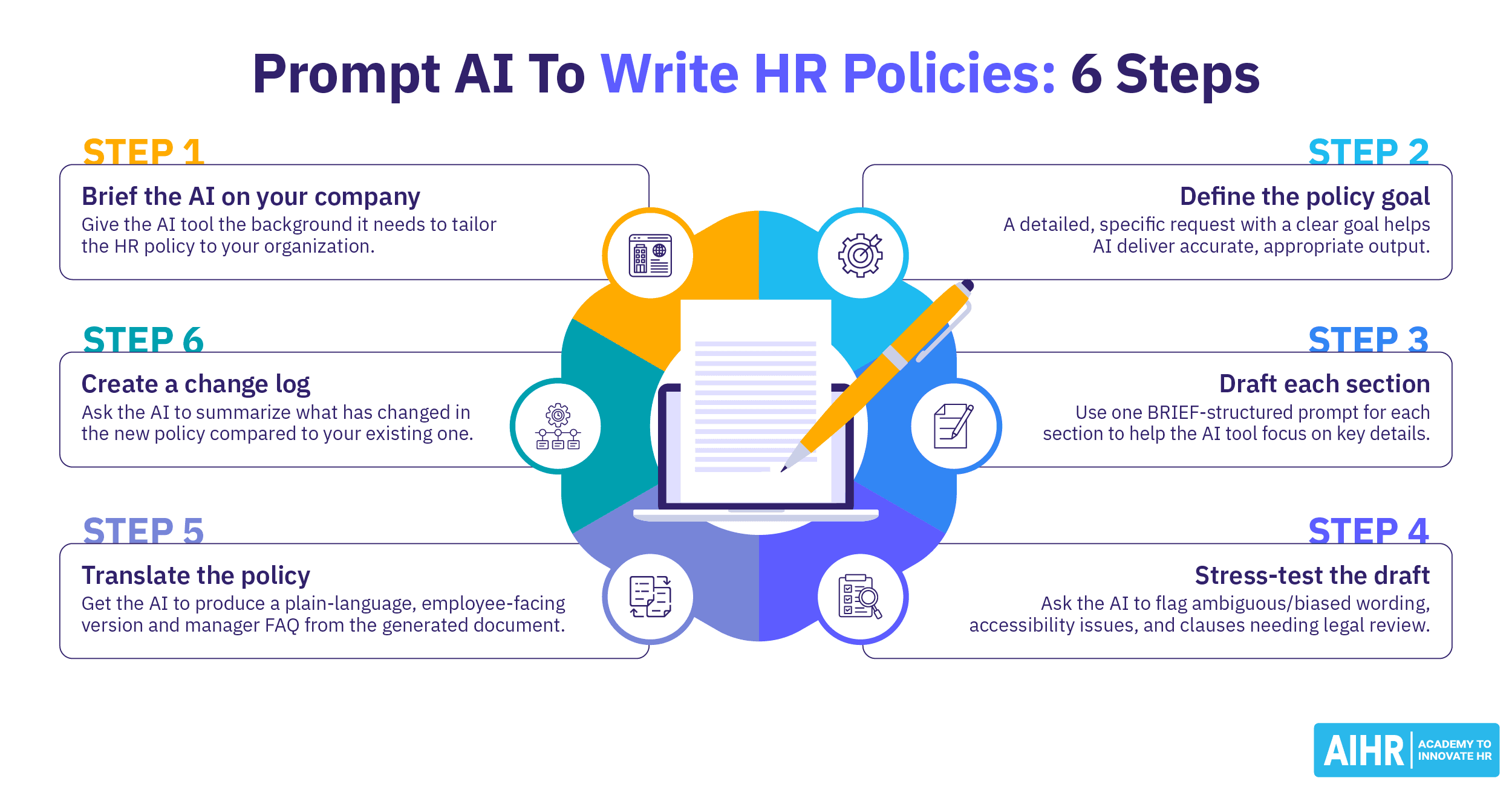
The quality of your AI-generated HR policy depends almost entirely on the quality of your prompt. A structured prompting framework helps you cover all the bases without forgetting critical details. One approach gaining traction in HR circles is the BRIEF framework, which stands for Background, Role, Instructions, Examples, and Format.
- Background: Give the AI context about your company — industry, size, geographic locations, and any relevant compliance requirements.
- Role: Ask the AI to act as a specific type of expert, such as an experienced HR policy writer or an employment law specialist. This shapes the tone and depth of the output.
- Instructions: Be explicit about what the policy needs to cover, what it should avoid, and what outcome you are aiming for.
- Examples: If you have sample policies you admire, share excerpts or describe what makes them work well. AI learns from examples as much as from direct instructions.
- Format: Specify how you want the output structured — headings, numbered sections, plain language, a certain word count — so you do not have to reformat everything later.
Using this kind of structured approach consistently will significantly improve the relevance and usability of your AI-generated drafts.
A Step-by-Step Process for Prompting AI to Write HR Policies
Even with a solid framework, it helps to think of AI-assisted policy writing as a multi-step process rather than a one-shot exercise. Here is a practical workflow to follow:
- Step 1 — Define the policy goal: Clarify the problem this policy is solving and the behavior or outcome it is meant to guide.
- Step 2 — Write your initial prompt using BRIEF: Layer in all the contextual details the AI needs to produce a relevant draft.
- Step 3 — Generate a first draft: Run the prompt and read the output critically. Do not accept it as final — use it as raw material.
- Step 4 — Identify gaps and inconsistencies: Check for missing sections, vague language, or anything that conflicts with your existing policies or legal requirements.
- Step 5 — Iterate with follow-up prompts: Ask AI to revise specific sections, adjust the tone, or expand on areas that feel underdeveloped.
- Step 6 — Human review and legal sign-off: Always have an HR professional and, where appropriate, legal counsel review the final draft before it is published or distributed.
The Risks of Using AI for HR Policy Writing
AI is a powerful tool, but it is not a risk-free one. HR professionals need to be aware of several important limitations before leaning too heavily on AI-generated content.
First, AI tools can produce confidently stated but legally inaccurate information. Employment law varies significantly by jurisdiction, and an AI model may not have the most current legislative updates, especially for highly specific local regulations. Always verify legal references against authoritative sources.
Second, AI-generated policies can feel impersonal or generic if not carefully tailored. Employees notice when documentation does not sound like their company, and that disconnect can undermine trust in the policy itself.
Third, there are data privacy considerations. Avoid inputting sensitive employee data or confidential business information into public-facing AI tools. Check your organization's data governance policies before using any AI platform for HR documentation.
Finally, over-reliance on AI can erode the critical thinking skills that HR professionals bring to policy design. Use AI as a collaborator, not a replacement. The strategic judgment, empathy, and organizational knowledge you bring to the table are things no AI tool can replicate.
Getting Started: Making AI Work for Your HR Team
Knowing how to write HR policies using AI is quickly becoming a core competency for modern HR professionals. The organizations that get ahead will be those that invest in learning how to prompt effectively, build repeatable workflows, and combine AI efficiency with human expertise.
Start small. Pick one policy that has been sitting in your backlog and try drafting it using the BRIEF framework. Refine, review, and learn from the process. Over time, you will develop a prompting style and a set of templates that make AI an indispensable part of your HR toolkit — saving hours of work and freeing you up for the people-focused responsibilities that matter most.