
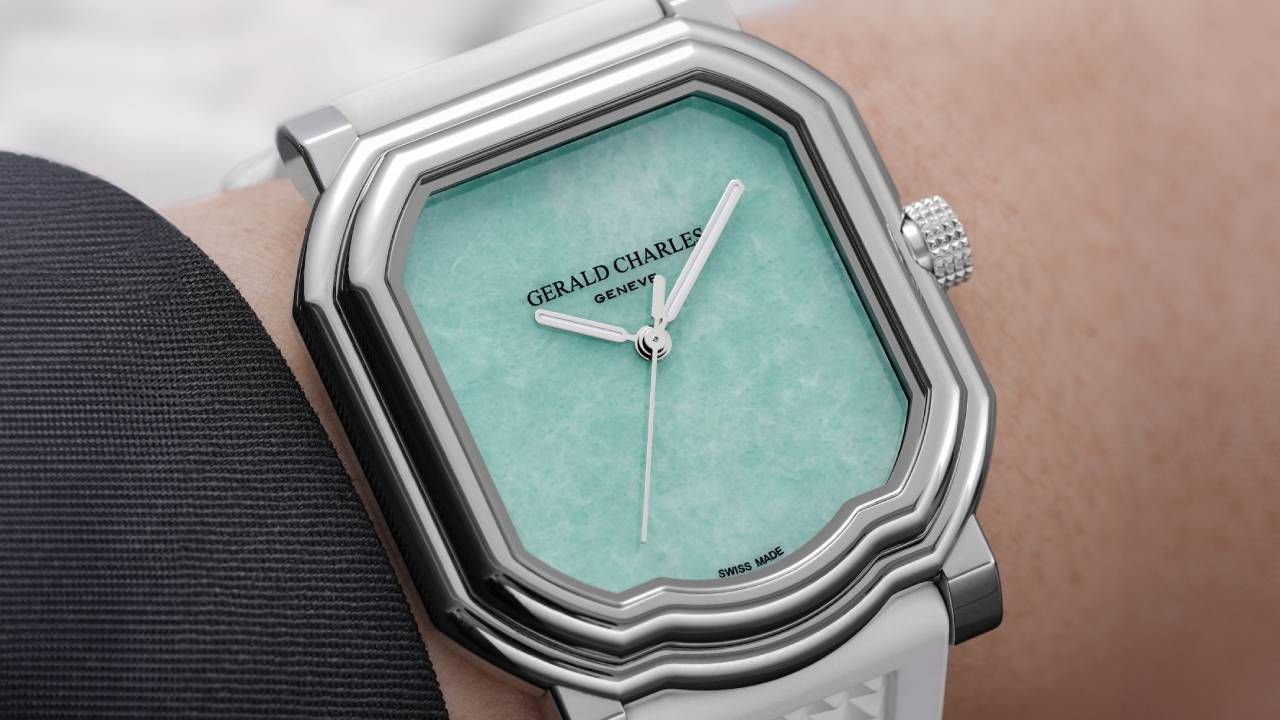
Gerald Charles Maestro: The Watch That Dares to Use Watchmaking's Most Difficult Gemstone
In the rarefied world of haute horlogerie, pushing boundaries is an expectation rather than a distinction. Brands compete on movement architecture, case finishing, and dial artistry. But every so often, a watch comes along that reframes the conversation entirely — not through mechanical innovation alone, but through an audacious material choice that most master watchmakers would simply walk away from. The new Gerald Charles Maestro is precisely that watch, and the gemstone at its heart is one that has frustrated, humbled, and defeated gem-setters across centuries of fine jewelry and watchmaking alike.
Who Is Gerald Charles?
Before diving into what makes this particular Maestro release so remarkable, it is worth understanding the brand behind it. Gerald Charles is a Geneva-based independent watchmaker founded on the legacy of Gerald Genta, one of the most celebrated watch designers in history — the man responsible for iconic silhouettes including the Audemars Piguet Royal Oak and the Patek Philippe Nautilus. The brand continues to honor that design DNA while carving its own identity through daring aesthetics, meticulous finishing, and a willingness to explore horological territory that larger maisons often avoid.
The Maestro collection is central to that identity. With its distinctive integrated bracelet, bold case geometry, and layered dial architecture, the Maestro has become a signature expression of what Gerald Charles stands for: watches that feel simultaneously classic and contemporary, restrained and daring.
What Makes a Gemstone "Difficult" in Watchmaking?
Not all gemstones are created equal — and in watchmaking, difficulty is measured along several very specific axes. A stone must not only be visually exceptional but also stable enough to survive the precision setting process, the vibrations of a mechanical movement, and the day-to-day rigors of being worn on the wrist.
The most commonly cited challenges include:
- Hardness and brittleness: Stones that rank high on the Mohs scale but exhibit directional cleavage can shatter under the pressure of a setting tool despite their surface hardness.
- Optical sensitivity: Certain gems change appearance dramatically under different light sources, making consistent color matching across a dial nearly impossible.
- Structural fragility: Some stones, despite their beauty, are prone to fracturing along internal fault lines when cut into the extremely thin slices required for watch dials and bezels.
- Rarity of matching specimens: Finding multiple stones with identical color, clarity, and cut from the same origin — in the tiny, precise dimensions required for a watch — can take years.
Opal is frequently cited as among the most demanding of all. Its internal play of color, known as opalescence, is formed by the diffraction of light through microscopic silica spheres — a structure that is also what makes opal extraordinarily vulnerable to cracking, crazing, and moisture damage. Cutting, calibrating, and setting opal to the tolerances demanded by haute horlogerie is a task that many of the world's finest gem-setters will simply decline.
The New Gerald Charles Maestro: A Closer Look
The latest Maestro release from Gerald Charles centers this notoriously challenging material as a primary design element rather than an accent. This is not a watch where a difficult stone has been cautiously placed as a single centerpiece surrounded by more forgiving diamonds. The entire design philosophy of this piece is built around the gemstone — allowing its natural character, depth, and unpredictability to drive the visual experience of the dial.
The result is a watch that looks fundamentally different in every lighting environment. Where most luxury watches present a consistent, controlled aesthetic, this Maestro shifts and evolves, offering the wearer a living, changing experience that cannot be replicated in any photograph or video. That quality alone places it in a category entirely its own.
The case, as with all Maestro references, maintains the brand's signature curved architecture and high-polish finishing contrasted against brushed surfaces — a technical finishing challenge in its own right. The integration of the bracelet flows seamlessly from the case, and the overall proportions balance presence with wearability in a way that reflects the Genta heritage the brand carries forward.
Why You Almost Certainly Won't Get One
The headline makes a blunt promise: you won't get one. This is not marketing hyperbole. When working with gemstones of this complexity, production quantities are not dictated by demand — they are dictated by availability and attrition. For every gem that makes it through the selection, cutting, calibration, and setting process intact and to specification, several others will have been lost. The number of finished watches that can be produced is therefore vanishingly small, often numbering in the single digits for any given reference.
Combined with Gerald Charles' already limited production volumes as an independent Geneva maison, and the brand's existing waitlist of collectors eager for every significant new reference, the realistic chance of a first-time buyer acquiring this specific piece approaches zero. Allocation will almost certainly be directed toward established relationships and long-standing clients.
What This Watch Represents for Independent Watchmaking
The significance of this Maestro release extends beyond its materials. It represents a growing trend among serious independent watchmakers to pursue craftsmanship challenges that are commercially irrational but culturally essential. These are watches made not because they can sell at scale, but because someone felt compelled to prove they could be made at all.
That philosophy — making the thing that should not be possible to make — is precisely what has kept watchmaking relevant and revered across centuries. The Gerald Charles Maestro with its near-impossible gemstone is a continuation of that tradition, a statement that the most meaningful watches are often the ones that exist in spite of every reasonable argument against them.
Final Thoughts
Whether or not you will ever hold one in your hands, the new Gerald Charles Maestro demands attention and respect. It is a reminder that true luxury is not merely about price — it is about the irreproducible human effort embedded in every component. The most difficult gemstone in watchmaking, set into one of Geneva's most thoughtfully designed cases, worn by a handful of collectors worldwide. That is not scarcity as a marketing strategy. That is simply the reality of doing something genuinely extraordinary.