
Redefining Strength: Why Vulnerability Is the Leadership Skill You've Been Ignoring
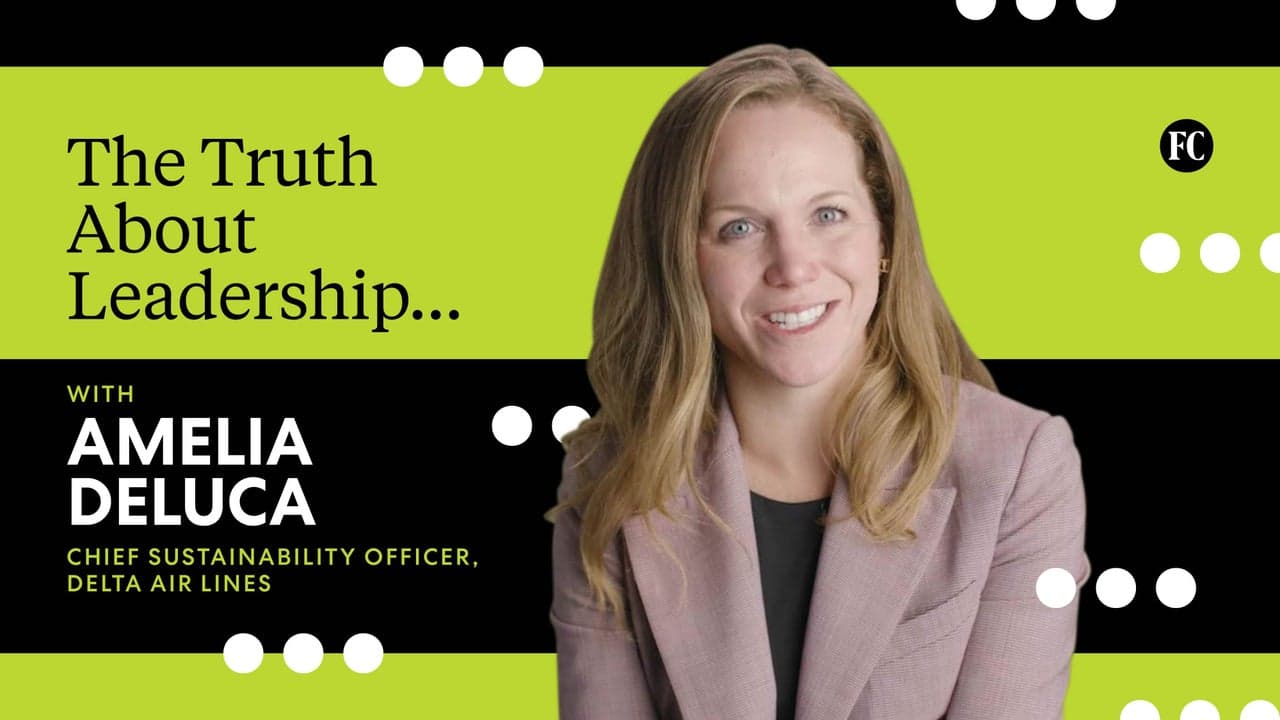
In a world that has long celebrated the stoic, unshakable leader—the one with all the answers, the one who never flinches—a quieter but far more powerful model of leadership is gaining traction. It's one built not on projected certainty but on courageous honesty. And few people embody this shift more compellingly than Amelia DeLuca, Delta Air Lines' Chief Sustainability Officer, whose approach to environmental leadership and organizational change offers a masterclass in what it truly means to lead with strength.
The idea that vulnerability is a weakness is one of the most pervasive and damaging myths in professional culture. Leaders who subscribe to it often build walls where they should be building bridges. They answer questions they don't fully understand rather than admitting uncertainty. They present polished strategies that mask messy realities. And in doing so, they lose the very thing that makes great leadership possible: authentic human connection.
DeLuca's truth challenges all of that—and it's a challenge worth listening to.
Who Is Amelia DeLuca, and Why Her Story Matters
As Delta's Chief Sustainability Officer, Amelia DeLuca sits at the intersection of some of the most complex and consequential challenges facing modern business: environmental responsibility, technological innovation, and large-scale organizational transformation. Her work involves guiding one of the world's largest airlines toward a more sustainable future while simultaneously ensuring that Delta remains competitive and resilient for the long haul.
That is not a small task. Aviation is one of the most carbon-intensive industries on the planet. The pressure to decarbonize while managing operational costs, regulatory demands, and passenger expectations requires a leader who is as comfortable with ambiguity as she is with strategy. And it turns out, DeLuca's willingness to be vulnerable—to acknowledge uncertainty, to invite collaboration, to show up as a full human being rather than a performance of authority—is central to how she navigates that complexity.
Her truth is simple but profound: vulnerability isn't something you survive in spite of your leadership. It is the foundation of your leadership.
The Science and Psychology Behind Vulnerable Leadership
DeLuca's leadership philosophy aligns closely with a growing body of research on psychological safety and high-performing teams. Pioneered by Harvard Business School professor Amy Edmondson, the concept of psychological safety describes environments where team members feel safe to take risks, share ideas, and admit mistakes without fear of punishment or humiliation. Studies consistently show that teams with high psychological safety are more innovative, more productive, and better at navigating change.
And what creates psychological safety? In large part, it's leaders who model vulnerability themselves. When a leader says "I don't have all the answers—let's figure this out together," they signal to their team that honesty is safe, that questions are welcome, and that imperfection is part of the process rather than a disqualifying failure.
In the sustainability space, where the science is rapidly evolving, where solutions are still being invented, and where the stakes could not be higher, this kind of leadership culture isn't just nice to have. It's operationally essential.
Vulnerability in the Context of Sustainability and Innovation
One of the most underappreciated aspects of DeLuca's role is how directly vulnerability supports innovation. Sustainability at the scale Delta operates demands that teams experiment, fail, learn, and iterate. It requires leaders to champion solutions that don't yet have proven track records and to make decisions under conditions of genuine uncertainty.
Leaders who cannot tolerate being wrong—or who cannot model comfort with not-knowing—tend to default to the familiar, the tested, and the safe. That instinct, while understandable, is precisely what stifles the kind of bold thinking that sustainability transformation requires. DeLuca's willingness to be openly honest about what she knows and what she doesn't creates the conditions in which her teams can think freely, propose boldly, and learn quickly.
This is how environmental leadership and organizational innovation intersect: through a culture of openness that starts at the top.
Practical Ways Leaders Can Embrace Vulnerability Without Losing Credibility
For leaders inspired by DeLuca's approach, the challenge is often knowing how to be vulnerable in practice without feeling exposed or undermining confidence. Here are several concrete strategies:
- Admit what you don't know—and make it a strength. Saying "I'm still learning about this, and here's what I know so far" signals intellectual honesty and invites collaboration rather than projecting false expertise.
- Share the process, not just the outcome. When leaders show their thinking, including the doubts and pivots along the way, teams build deeper trust and a more realistic understanding of how good decisions actually get made.
- Ask more questions than you answer. Vulnerable leaders are curious leaders. They draw out insights from their teams rather than positioning themselves as the sole source of wisdom.
- Acknowledge mistakes openly and early. Owning an error before being called out for it is one of the most credibility-building things a leader can do.
- Model emotional honesty. Sharing that a challenge is difficult, that the stakes are high, or that you feel the weight of a decision humanizes leadership and deepens team loyalty.
Long-Term Leadership and Organizational Change: The DeLuca Framework in Action
What makes DeLuca's leadership model particularly instructive for organizations undergoing major transformation—whether that's a sustainability overhaul, a digital shift, or a cultural evolution—is that it scales. Vulnerable leadership isn't just effective in one-on-one relationships. It creates organizational cultures that are more adaptable, more honest, and more resilient over time.
Change management research consistently shows that transformations fail not because of flawed strategy but because of insufficient trust. Employees don't buy into change they don't believe in, and they don't believe in change championed by leaders they don't trust. Vulnerability—authentic, consistent, and courageous—is the trust-building mechanism that makes change possible.
For Delta, whose long-term growth depends on successfully navigating both environmental pressures and operational disruption, DeLuca's leadership philosophy is not a soft skill sideline. It is core infrastructure.
The Takeaway: Your Vulnerability Is Your Competitive Edge
Amelia DeLuca's truth about leadership is a call to rethink the assumptions most of us inherited about what strength looks like in a professional context. The leaders who will define the next era of organizational success—especially in the high-stakes, fast-evolving world of sustainability and technology—won't be the ones who project the most certainty. They'll be the ones who build the most trust. And trust, it turns out, is built through honesty, humility, and the courage to be seen as fully human.
Vulnerability isn't a liability you manage around. It's a leadership advantage you lean into. DeLuca's work at Delta is living proof of that—and it's a model worth following.