
When Betting on One Future Isn't Enough
In 2024, electric vehicle startup Fisker filed for bankruptcy — not because it lacked vision, and not because it failed to anticipate the rise of electric mobility. It filed for bankruptcy because it prepared for only one version of the future, and that version never fully arrived.
Fisker, like many EV optimists, built its entire strategy on a set of assumptions: EV adoption would keep accelerating, investor capital would remain plentiful, and consumers would eagerly welcome new automotive brands challenging the traditional establishment. What actually happened was very different. Interest rates climbed sharply, consumer demand for EVs slowed, competition intensified dramatically — particularly from well-capitalized incumbents and aggressive Chinese manufacturers — and funding dried up faster than anyone anticipated.
The result was a cautionary tale that extends far beyond the auto industry. Fisker's collapse is not simply a story about one company's misfortune. It is a warning to every organization operating in today's fast-moving, deeply uncertain environment: designing for a single future is a fragile strategy, and fragile strategies eventually break.
The Danger of Single-Scenario Thinking
Most companies, when developing strategy, implicitly commit to one dominant narrative about how the world will unfold. They build their operations, hire their talent, structure their finances, and design their products around that narrative. When the narrative holds, they look brilliant. When it doesn't, they are often left without the flexibility to recover.
This is precisely what happened at Fisker. The company wasn't blindsided by a random black swan event. It was undone by a convergence of foreseeable risks — macroeconomic shifts, evolving consumer sentiment, competitive dynamics, and capital market volatility — that any truly resilient organization should have accounted for in its planning process.
Andrew Grove, the legendary former CEO of Intel, famously warned that "Success breeds complacency. Complacency breeds failure." The same logic applies to strategic assumptions. When early momentum seems to validate a particular worldview, organizations stop questioning it. They stop stress-testing. They stop asking, "What if we're wrong?" And that is precisely the moment they become vulnerable.
Uncertainty Is the New Normal
To be fair, Fisker was operating in an environment that has become increasingly difficult to navigate for any organization, in any industry. The pace of disruption is accelerating on multiple fronts simultaneously.
Artificial intelligence is compressing the timelines between opportunity and execution in ways that were unimaginable just a few years ago. A competitive advantage that once lasted a decade may now last eighteen months. Geopolitical tensions are reshaping global supply chains and trade relationships overnight. Regulatory environments are shifting unpredictably as governments scramble to respond to technological and social change. Talent markets remain volatile and increasingly competitive across critical skill areas.
In this context, the ability to predict the future accurately is less important — and frankly less achievable — than the ability to respond effectively to whatever future actually arrives. Organizations that understand this distinction are the ones building genuine, lasting competitive advantage.
What Adaptive Organizations Do Differently
High-performance organizations don't simply hope their predictions will be correct. They deliberately design themselves to function well across a range of possible scenarios. This requires a fundamentally different approach to strategy, culture, and workforce development.
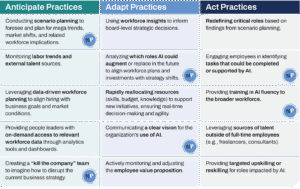
Rather than optimizing entirely around a single forecast, adaptive organizations challenge their own assumptions on a regular basis. They conduct scenario planning exercises that force leadership teams to confront uncomfortable possibilities. They pressure-test their business models against variables they cannot fully control — interest rate environments, regulatory changes, demand fluctuations, new competitive entrants.
They also invest in building cultures where agility isn't just a buzzword plastered on a conference room wall. Agility, in the truest sense, is a deeply embedded behavioral and cultural trait. It means employees at every level are empowered to identify signals of change, surface concerns without fear, and pivot their approach when circumstances shift. That kind of organizational reflexivity doesn't happen by accident — it is deliberately cultivated over time.
Building a Workforce Designed for Multiple Futures
Perhaps the most consequential dimension of organizational adaptability is workforce design. Companies that prepare only for one future tend to hire, train, and develop talent in narrow, highly specialized ways optimized for that predicted future. When the future changes, they find themselves with a workforce that is skilled for a world that no longer exists.
Adaptive organizations invest in broader capability development. They prioritize learning agility — the ability of individuals to acquire new skills and apply them quickly — alongside technical expertise. They build cross-functional fluency so that teams can reconfigure and collaborate across boundaries when circumstances demand it. They create psychological safety so that employees feel comfortable acknowledging when current approaches aren't working and proposing alternatives.
In an AI-disrupted world, this kind of workforce adaptability is not a nice-to-have. It is a survival requirement.
The Real Lesson From Fisker
Fisker's bankruptcy is not a story about the failure of the electric vehicle industry. EVs are, by most indicators, still the future of transportation. The story is about what happens when an organization mistakes a compelling vision for a guaranteed outcome and builds its entire existence around that assumption without building in the resilience to survive being wrong.
The organizations that will thrive in the years ahead are those that take this lesson seriously. Not by becoming paralyzed with uncertainty, but by designing themselves — their strategies, their cultures, and their workforces — to adapt, learn, and evolve no matter which version of the future ultimately arrives. In a world defined by disruption, adaptability isn't a competitive advantage. It's the foundation everything else is built on.