
Are HR Certifications Worth It To Land Your Dream HR Job?
You can check nearly every box on an HR job posting — the right education, the relevant experience, even the industry background — and still stop cold at a single line: "HR certification preferred." It is easy to read that as a signal that a credential is the one missing piece standing between you and the role you want. Sometimes, it genuinely is. But the full picture is more nuanced than that, and understanding it can save you significant time and money while making your job search far more effective.
So, are HR certifications worth it? The short answer is yes — but only when the credential helps you prove you are ready for the specific HR role you are targeting. This guide breaks down when certification strengthens your application, when hands-on experience carries more weight, and how to translate a credential into the kind of concrete evidence that hiring managers actually trust.
What Hiring Managers Really Look for in HR Candidates
Before spending months studying for an HR certification exam, it is worth understanding what employers are actually evaluating when they review HR applications. A certification can signal foundational knowledge, but it rarely operates in isolation.
Hiring managers typically look for a combination of the following:
- Core HR knowledge: Understanding of the full employee lifecycle, from recruiting and onboarding through compliance, compensation, benefits, and employee relations.
- Practical experience: Evidence that you have applied HR concepts in real workplace settings, not just studied them in theory.
- Business acumen: The ability to connect HR decisions to broader organizational goals and outcomes.
- Communication and interpersonal skills: HR professionals interact with employees at every level, which means soft skills matter as much as technical ones.
- Adaptability: HR landscapes shift constantly due to changing labor laws, workforce trends, and organizational needs.
A certification can address the first point directly. For the others, you need to demonstrate real-world competency through your resume, your portfolio, and your interview performance.
What an HR Certification Actually Does for Your Job Search
A recognized HR certification functions primarily as a trust signal. It tells an employer that you have met a defined standard of knowledge in core HR disciplines. That matters most in three specific situations.
First, when you are breaking into HR from a different field. If your resume does not include direct HR job titles, a credential like the SHRM-CP or PHR can help bridge the credibility gap and show employers you have invested in the profession.
Second, when you are competing in a crowded applicant pool. For high-volume HR roles at large organizations, a certification can help your application clear initial screening filters — whether human or automated — before a recruiter ever reads your experience section.
Third, when you are aiming at roles that explicitly require or strongly prefer certification. Some senior HR positions and specialized roles in compensation, benefits, or HR compliance treat certification as a genuine baseline requirement rather than a nice-to-have.
Outside of these situations, certification alone is unlikely to be the deciding factor. Employers hiring for most mid-level HR roles are weighing your track record just as heavily, if not more so, than your credentials.
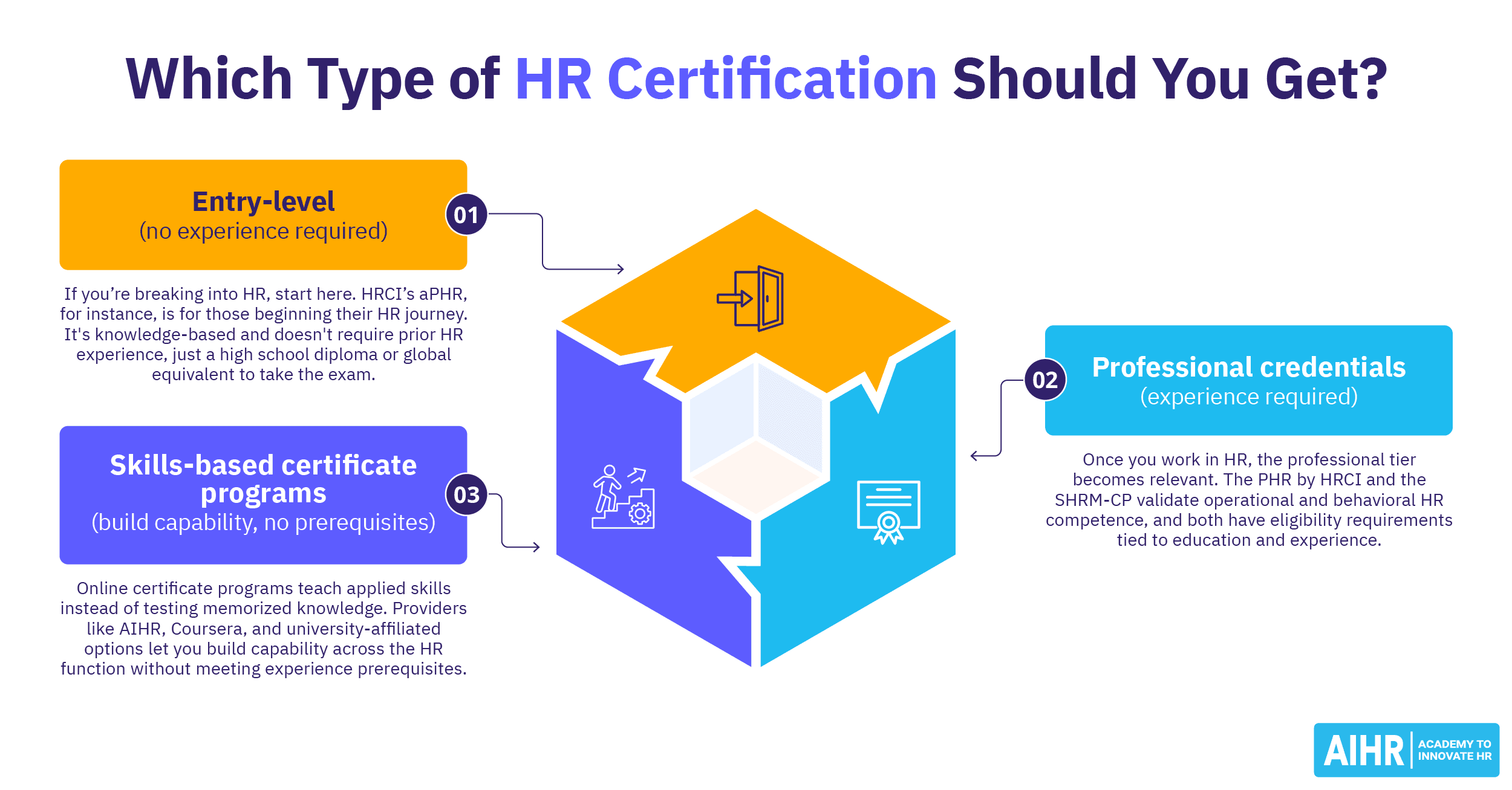
Which HR Certification Matches Your Situation?
Choosing the right certification matters as much as deciding to pursue one at all. The HR certification landscape is broad, and the best option depends on your career stage, your specialization, and your geographic market.
Entry-Level and Early-Career HR Professionals
If you are just starting out or transitioning into HR, certifications designed for generalist knowledge are typically the most useful starting point. The SHRM-CP (Society for Human Resource Management Certified Professional) and the PHR (Professional in Human Resources from HRCI) are both widely recognized in the United States and demonstrate competency across core HR functions. These credentials are well-suited for HR coordinators, HR assistants, and those moving into their first dedicated HR role.
Mid-Career HR Professionals
If you already have several years of HR experience and are looking to advance into a senior individual contributor or people management role, more advanced credentials become relevant. The SHRM-SCP and SPHR are both designed for professionals with deeper experience who want to demonstrate strategic HR capability. Specialized certifications in areas like compensation (such as the Certified Compensation Professional designation) or HR analytics are also worth considering if your target roles have a clear functional focus.
International HR Roles
If you are targeting roles outside the United States or working within multinational organizations, look for globally recognized credentials. The GPHR (Global Professional in Human Resources) from HRCI addresses international HR management and is particularly relevant if cross-border employment compliance or global mobility is part of the role.
Certification and Practical Skills: How They Work Together
The most common mistake HR job seekers make is treating certification as a substitute for practical skill-building rather than a complement to it. A certificate on your resume opens doors. What happens in the interview room depends on what you have actually done.
To make your certification work harder in a job search, connect it explicitly to real experience. On your resume, list accomplishments that align with the competency areas your certification covers. In interviews, use examples that show you have applied that knowledge — not just passed a test about it.
It also helps to continue building skills after you earn your credential. HR is a field that evolves quickly, with new tools, workforce dynamics, and legal requirements emerging regularly. Employers notice candidates who demonstrate curiosity and ongoing development alongside their formal credentials.
Ultimately, an HR certification is worth pursuing when it fills a specific gap in your profile, aligns with the roles you want, and is backed by the practical experience to give it context. Treat it as one strong piece of a complete application — and build the rest of that application with equal care.