
Work-Life Balance for Working Parents Is a Myth — Here's What the Data Actually Shows
Work-life balance has long been held up as the ultimate goal for the modern professional. Employers tout it in job listings, wellness coaches build entire careers around it, and yet for millions of American parents, it remains firmly out of reach. In fact, according to a sweeping new study from the Pew Research Center, the concept of balance may be less a realistic target and more a comforting illusion — particularly for those raising children while holding down a job.
The data is striking. It paints a picture not of two neatly separated spheres — work on one side, family on the other — but of a deeply tangled reality where the boundary between professional and personal life has all but dissolved. For working parents across the United States, this isn't a temporary disruption. It's simply life.
What the Pew Research Center Study Found
Conducted among 2,242 working parents in the U.S., the Pew Research Center survey offers one of the most detailed looks yet at how parents are managing — or struggling to manage — the dual demands of employment and caregiving. The results are telling.
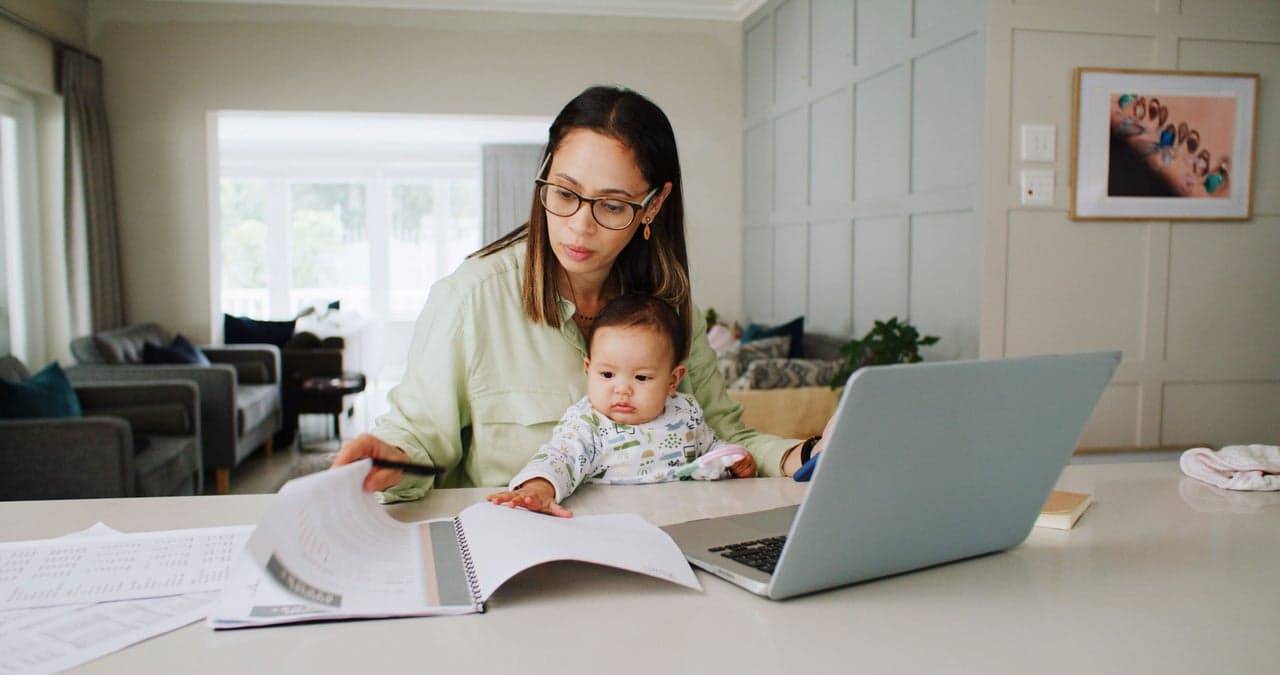
Among full-time working parents, a full 70% reported handling parenting-related tasks while on the job. Meanwhile, 59% said they took care of work responsibilities while spending time with their children. In other words, the bleed runs in both directions: parenting interrupts work, and work interrupts parenting. Neither domain gets anyone's full attention, and both end up competing for the same limited hours in a day.
More than half of the parents surveyed said it was genuinely difficult to balance their work and family lives. An equally significant share said that their job made it harder to be a good parent — a finding that carries real emotional weight. And nearly half (45%) said that being a parent made it more difficult to advance in their career, suggesting that the costs of this imbalance aren't just personal. They're professional, too.
Even part-time work offered little relief. Over half of part-time working parents still reported that achieving work-life balance was a challenge, undermining the common assumption that cutting back on hours is a reliable fix for the problem.
Working Mothers Bear a Disproportionate Burden
While the challenges of balancing work and parenting are widespread among all parents, working mothers face a measurably heavier load. A striking 81% of women surveyed said they dealt with parenting tasks during work hours, and 38% reported doing so very often — not occasionally, not every now and then, but as a routine feature of their workday.
This data aligns with a broader body of research showing that working mothers in America are under significant and sustained pressure. The mental load of parenting — the planning, the scheduling, the anticipating of needs — falls disproportionately on women, and that invisible labor doesn't clock out when a woman logs into a work meeting or responds to a professional email.
That said, fathers are not exempt from these pressures. A substantial 62% of fathers in the survey also reported managing parenting responsibilities during work hours. The challenges are pervasive across genders, even if they are not equally distributed. This suggests that the struggle to balance work and family is not simply a "women's issue" — it is a structural problem that affects entire households and demands systemic solutions.
Why Work-Life Balance Is So Hard for Parents to Achieve
The concept of work-life balance was conceived in an era when work and home were more clearly defined spaces with more predictable boundaries. A parent went to the office, came home, and the two worlds stayed relatively separate. That model — always imperfect — has effectively collapsed for a large portion of the workforce.
Several forces are driving this collapse. The rise of remote and hybrid work, while offering flexibility, has also erased the physical separation between professional and domestic spaces. A child's school call can interrupt a client presentation. A work emergency can intrude on a family dinner. When home is also the office, the mental and emotional separation becomes nearly impossible to maintain.
Add to this the rising cost of childcare, the shortage of affordable and accessible after-school programs, and workplaces that have not structurally adapted to the realities of modern parenting, and the picture becomes even clearer. Working parents are not failing at balance because of poor personal habits or a lack of time management skills. They are navigating a system that was not designed with their reality in mind.
What Can Actually Help Working Parents
Given how deeply embedded these challenges are, individual tips and productivity hacks will only go so far. Real improvement requires action at multiple levels.
Employers can make a meaningful difference by offering genuinely flexible scheduling, normalizing the use of parental leave for all genders, and building cultures where employees are not penalized for having caregiving responsibilities. Policies like subsidized childcare benefits, school-hour-aligned work options, and protected family time can shift the dynamic considerably.
On a policy level, stronger federal and state investment in affordable childcare and paid family leave would address some of the structural gaps that leave parents — especially mothers — without adequate support. Countries with robust public childcare systems consistently see better outcomes for working parents across all economic levels.
For parents themselves, the most useful reframe may be letting go of the idea of perfect balance altogether. Rather than striving for an even split, many experts now advocate for the concept of integration — finding rhythms that allow work and family to coexist without one constantly cannibalizing the other.
The Bottom Line
The Pew Research Center's findings confirm what many working parents already know intuitively: the wall between work and family life has crumbled. For the majority of parents — and especially for mothers — neither domain ever gets their undivided attention, and the strain of living in that gap is real and measurable. Acknowledging that work-life balance, as traditionally defined, is not achievable for most working parents isn't defeatist. It's the honest starting point for building something better.