
What Is a Talent Review and Why Does It Matter in 2026?
A talent review is a structured process in which HR teams and business leaders evaluate employees' performance, potential, skills, and readiness for future roles. Far from being a routine HR checkbox, it is one of the most strategically important conversations an organization can have — especially as roles, technologies, and business priorities shift at an accelerating pace.
The urgency is real. According to Deloitte, 77% of business leaders believe organizations should actively help employees build relevant skills. Yet only 5% strongly agree their companies are investing enough in new skills development. That gap is precisely where talent reviews come in. When done well, they surface the people who are ready to grow, identify where critical skills are missing, and give leaders the clarity they need to act before problems become crises.
In 2026, talent reviews are no longer just about spotting high-potential employees. They serve as the foundation for succession planning, internal mobility, leadership development, and workforce planning. If your organization isn't conducting them — or conducting them effectively — you're making critical workforce decisions without complete information.
The Core Goals of a Talent Review
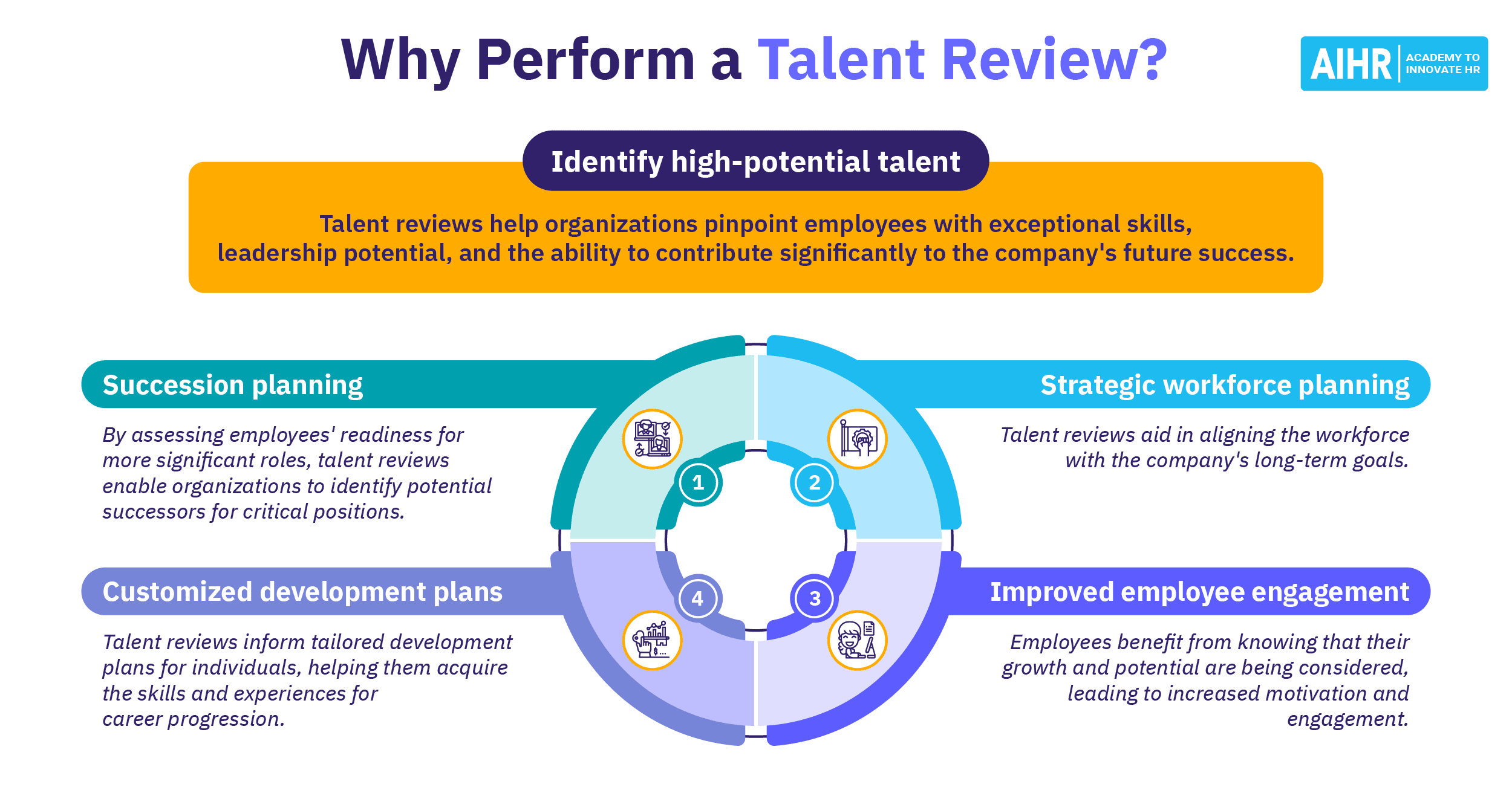
Before you design a talent review process, it helps to be clear about what you're trying to achieve. Most organizations use talent reviews for one or more of the following purposes:
- Succession planning: Identifying potential successors for critical roles before gaps appear, ensuring leadership continuity without scrambling at the last minute.
- Development prioritization: Deciding where to invest learning and development resources so that people with the highest potential and growth readiness receive meaningful opportunities.
- Internal mobility: Discovering employees who are ready — or nearly ready — for lateral or upward moves, reducing the need for expensive external hiring.
- Risk reduction: Recognizing leadership dependencies, flight risks, or skills gaps that could threaten business performance if left unaddressed.
- Alignment with strategy: Ensuring that talent decisions reflect where the business is headed, not just where it has been.
The clearer your goals, the more focused and productive your talent review conversations will be.
Step-by-Step: How To Conduct a Talent Review
Step 1: Define the Scope and Purpose
Start by deciding which employee population you're reviewing and why. Are you assessing all employees across a business unit? Focusing on manager-level and above? Reviewing a specific function ahead of a restructuring? Knowing your scope keeps the process manageable and ensures the output is relevant to the decisions you need to make.
Step 2: Gather the Right Data
Effective talent reviews are grounded in data, not just gut feeling. Collect performance ratings from the most recent review cycle, feedback from managers and peers, information about skills and competencies, engagement scores, and any relevant career development conversations. The goal is to give reviewers a complete, evidence-based picture of each employee before the calibration session begins.
Step 3: Align on Definitions and Criteria
One of the most common failure points in talent reviews is inconsistency. What does "high potential" actually mean in your organization? How is "performance" being defined — output, behavior, or both? Before any names go on a grid, your leadership team must agree on shared definitions. This alignment step prevents bias, reduces subjectivity, and makes calibration conversations far more productive.
Step 4: Use the 9-Box Grid for Structured Conversations
The 9-box grid is one of the most widely used tools in talent reviews. It plots employees on a matrix with performance on one axis and potential on the other, creating nine distinct categories that range from employees who are struggling in their current role to those who demonstrate exceptional performance and the capacity to take on significantly greater responsibility.
Used thoughtfully, the 9-box grid helps structure review conversations, makes patterns visible across a team or business unit, and supports more equitable calibration. However, it is only as reliable as the criteria behind it. Placing someone in a box without agreed definitions leads to inconsistent, unfair, and ultimately unhelpful outcomes. Always document the rationale for each placement.
Step 5: Facilitate the Calibration Session
The calibration session is where managers and HR leaders review placements together, challenge assumptions, share perspectives, and reach a shared view of the talent landscape. A skilled HR business partner typically facilitates this discussion to keep it focused, ensure all voices are heard, and flag when personal biases might be influencing assessments. This is not the place for consensus for its own sake — it's the place for honest, informed dialogue.
Step 6: Translate Outcomes Into Action
A talent review that doesn't lead to action is little more than a conversation. Every employee who is discussed should have a clear next step, even if that step is simply "continue in current role with no immediate change." For high-potential employees, this might mean a stretch assignment, a leadership development program, or an accelerated promotion path. For employees who are underperforming, it might mean a structured performance improvement plan or a role change discussion. Internal mobility opportunities should be actively surfaced and pursued.
Choosing the Right Talent Review Framework
The 9-box grid is the most common framework, but it isn't the only one. Some organizations prefer a skills-based lens, assessing employees against a defined capability framework tied to future business needs. Others use a readiness model that focuses specifically on succession pipeline health, rating employees as "ready now," "ready in one to two years," or "longer-term development." The right framework depends on your organizational maturity, your current business priorities, and the quality of data you have available.
Regardless of which framework you choose, three principles hold across all of them: use clear and consistent criteria, involve multiple perspectives in assessments, and connect outcomes to meaningful action.
Common Mistakes To Avoid
- Recency bias: Evaluating employees only on their most recent performance rather than sustained contribution and demonstrated growth.
- Manager advocacy without calibration: Allowing individual managers to advocate for their own team members without cross-functional challenge or scrutiny.
- No follow-through: Conducting reviews and then failing to communicate outcomes or deliver on development commitments, which erodes trust quickly.
- Overcomplicating the process: Adding so much administrative overhead that managers disengage and the quality of input suffers.
Making Talent Reviews a Strategic Habit
The organizations that get the most value from talent reviews treat them as an ongoing discipline, not an annual event. Scheduling reviews at least once a year — and revisiting succession pipelines and development plans quarterly — keeps the talent conversation connected to business reality as it evolves. When talent reviews are embedded in how leaders think about their teams, they become one of the most powerful tools in any HR strategy.
In 2026, with skills gaps widening and organizational agility becoming a competitive advantage, there has never been a better time to make talent reviews a cornerstone of how you manage and grow your people.