
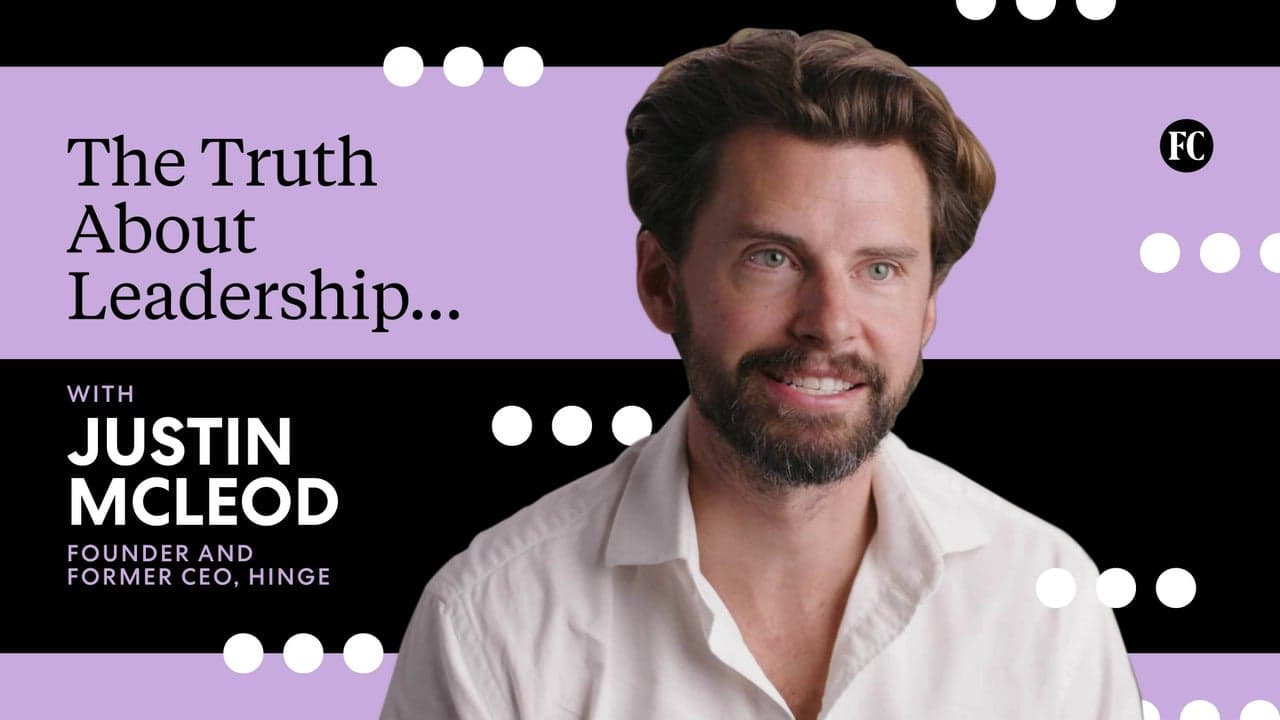
The Side of Leadership Nobody Talks About
When we think about the most successful founders in tech, we tend to focus on the metrics: the user growth, the valuation milestones, the magazine covers. What rarely makes headlines is what those founders feel at 2 a.m. when the weight of the company presses down on them alone. Justin McLeod, the founder of Hinge and CEO of Overtone, is one of the rare leaders willing to pull back the curtain on that quieter, heavier side of building something meaningful.
In a world that celebrates hustle culture and stoic leadership, McLeod's candor is not just refreshing — it's necessary. His acknowledgment of the emotional burden that comes with building a company centered on human relationships challenges every founder, executive, and aspiring leader to ask a harder question: what is leadership really costing you?
Who Is Justin McLeod?
Justin McLeod is best known as the founder of Hinge, the dating app that famously positioned itself as "designed to be deleted." That mission statement alone says something profound about the man behind it. Rather than engineering addiction and maximizing screen time like so many of his peers in the app economy, McLeod built a product explicitly oriented toward helping people leave it behind — because they found real love.
That kind of thinking doesn't come from a spreadsheet. It comes from a place of deep personal experience, emotional intelligence, and a willingness to build from vulnerability. McLeod has spoken publicly about his own struggles with love, loss, and self-discovery, and how those experiences directly shaped Hinge's philosophy.
Today, as CEO of Overtone, he continues operating at the intersection of technology and human connection — a space that demands not only strategic clarity but emotional endurance.
What Is the Emotional Cost of Leadership?
The emotional cost of leadership is rarely quantified in business school curricula or board presentations. But it is real, pervasive, and often invisible until it becomes a crisis. For leaders like McLeod, who build products rooted in human intimacy and emotional experience, that cost can be even more acute.
Leadership carries a particular kind of loneliness. Founders and CEOs are expected to project confidence, hold the vision steady, and inspire those around them — often at the very moments when they feel least certain. They absorb the anxieties of their teams, carry the disappointment of investors during hard quarters, and internalize the gap between what the company is and what they believe it could be.
There are several dimensions to this hidden toll that McLeod's story helps illuminate:
- Identity entanglement: When you build something deeply personal, the line between who you are and what you've created becomes dangerously thin. Success feels like validation; failure feels like annihilation. For McLeod, building a company about love meant his work was never just professional — it was existential.
- Chronic uncertainty: Leaders must make high-stakes decisions with incomplete information, day after day, year after year. That sustained ambiguity creates a low-grade psychological stress that accumulates quietly over time.
- Emotional labor at scale: Leading a team means managing not just deliverables, but human beings — their fears, their conflicts, their aspirations. For empathetic leaders, that labor is immense and rarely acknowledged as work at all.
- The performance of confidence: There is a profound toll in being expected to appear certain when you are not, to inspire when you are exhausted, and to hold space for others when you yourself need holding.
Why Vulnerability in Leadership Is a Competitive Advantage
One of the most important lessons McLeod models is that acknowledging the emotional weight of leadership is not weakness — it is strategy. Leaders who suppress their emotional reality don't eliminate it; they merely drive it underground, where it tends to leak out in less healthy ways: poor decisions, damaged relationships, eroded culture.
Research in organizational psychology increasingly supports what people like McLeod embody intuitively. Psychologically safe leadership cultures — where leaders model openness and emotional honesty — produce teams that are more innovative, more resilient, and more capable of navigating uncertainty. When a leader says "this is hard, and I don't have all the answers," they give their team permission to be human too.
For tech companies especially, which have long romanticized the image of the relentless, emotion-free founder, this represents a significant cultural shift. McLeod is part of a new generation of leaders redefining what it means to be effective — and that definition increasingly includes emotional intelligence, self-awareness, and the courage to be honest about struggle.
How Leaders Can Begin to Address the Hidden Emotional Cost
Awareness is the starting point, but it cannot be the ending point. If McLeod's truth resonates, the next step is action. There are practical ways leaders can begin to reckon more honestly with the emotional costs of their roles.
- Normalize therapy and coaching: Having a trusted, confidential space to process the pressures of leadership is not a luxury — it is a professional necessity. The best leaders invest in their psychological fitness with the same rigor they invest in their strategic thinking.
- Build peer networks: The isolation of leadership is real, but it is also partially self-imposed. Connecting with other founders and executives who understand the terrain creates community where honesty can flourish without professional consequence.
- Create cultures that permit imperfection: Leaders set the tone. When a CEO acknowledges a mistake openly or admits uncertainty in a team meeting, they send a signal that reverberates through the entire organization.
- Separate identity from outcome: Learning to hold the company's journey with some psychological distance — recognizing that its setbacks do not define your worth — is one of the most difficult and most important skills a founder can develop.
Leadership Is Human Work
Justin McLeod built Hinge on the belief that technology could serve human connection rather than exploit it. That same belief — that the human dimension is not incidental but central — applies just as powerfully to leadership itself. The most enduring companies are built by people who understand that leading is human work, and that human work has a cost.
Talking about that cost openly, as McLeod does, is not a confession of failure. It is the clearest possible sign of someone who leads with their whole self — and in doing so, gives others permission to do the same. In the long arc of building something that lasts, that kind of honesty may be the most powerful foundation of all.