
Why Data Privacy and Ethics in AI for HR Can No Longer Be Ignored
Artificial intelligence is reshaping human resources at a remarkable pace. From screening candidates and forecasting attrition to managing performance and personalizing employee development, AI-powered tools are now embedded at every stage of the employee lifecycle. Yet as organizations lean more heavily on these systems, a critical question emerges: can HR leaders truly trust the data driving those decisions?
According to Deloitte's Global Human Capital Trends research, 95% of executives are concerned about the accuracy of data used in AI-enabled talent processes. That statistic alone signals just how urgent data privacy and ethics in AI for HR have become. Before any organization can trust an AI recommendation, it must first trust the data behind it — and right now, that trust is far from guaranteed.
HR's responsibility has evolved significantly. It is no longer enough to simply protect employee information from external breaches. Today's HR leaders must ensure that workforce data is accurate, fair, transparent, and governed with the same rigor applied to financial or legal data. Failing to do so doesn't just create compliance risk — it creates the conditions for biased hiring, discriminatory performance reviews, and decisions that harm real people.
The Growing Role of AI in People Decisions
AI in HR is not a future trend — it is an operational reality. Recruiting platforms use machine learning to rank candidates. Workforce planning tools use predictive analytics to flag flight risks. Performance management systems use AI to surface patterns in productivity data. Employee development platforms use algorithms to recommend learning paths based on career trajectories.
Each of these use cases involves collecting, storing, processing, and acting on sensitive personal data. And because AI systems learn from historical data, any bias or inaccuracy embedded in that data gets amplified at scale. This is what makes data quality and ethical governance not just a technical challenge but a leadership imperative for HR.
Key Data Privacy and Ethical Risks of AI in HR
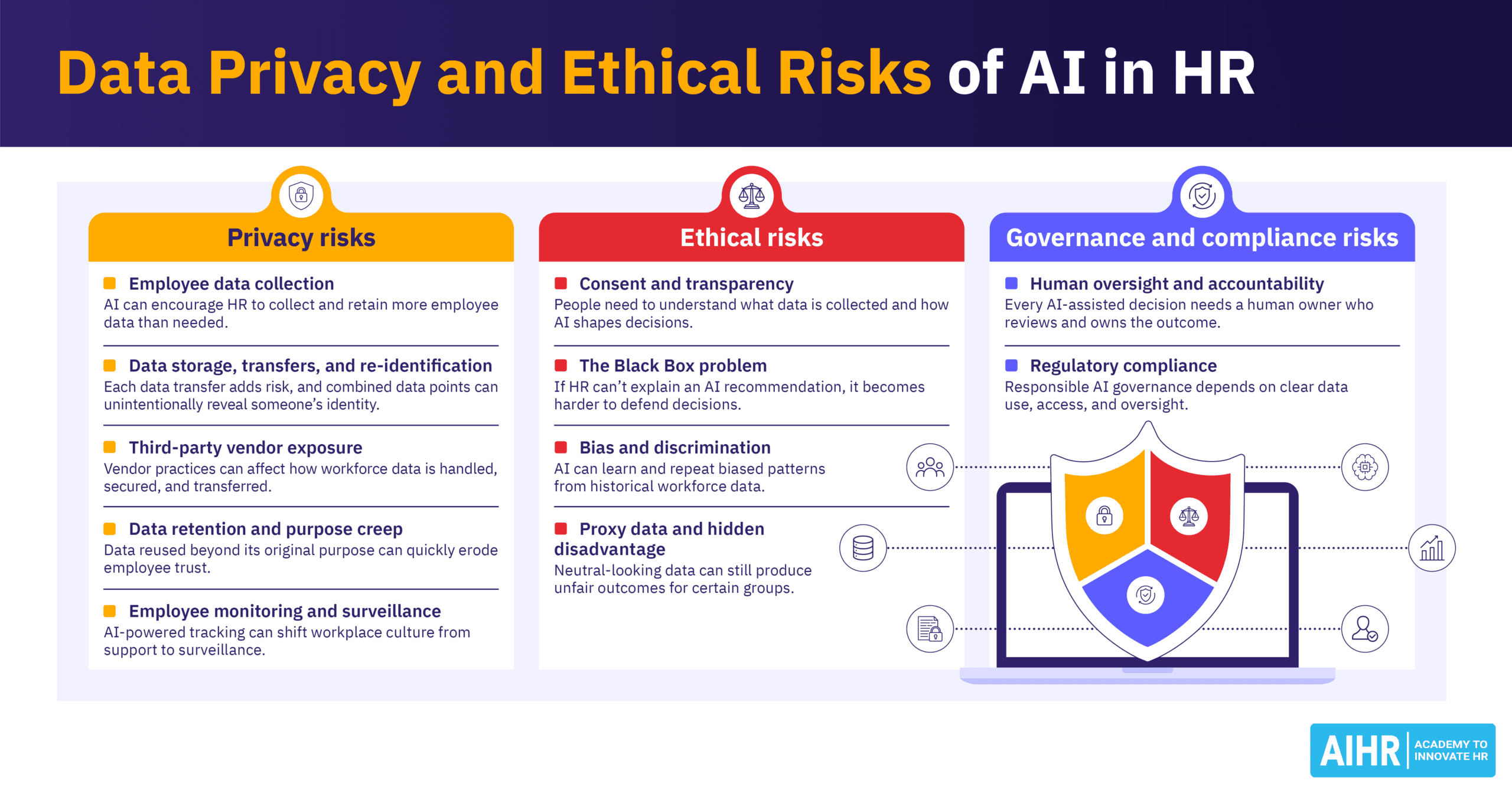
Understanding the risks is the first step toward managing them. HR leaders should be aware of the following challenges that arise when AI intersects with people data.
Algorithmic Bias and Discrimination
AI models trained on historical hiring or performance data can perpetuate existing biases. If past promotion decisions skewed toward certain demographic groups, an AI system will learn to replicate that pattern — creating discriminatory outcomes that are harder to detect precisely because they appear objective.
Lack of Transparency and Explainability
Many AI systems operate as black boxes, producing recommendations without clear explanations. When an employee is passed over for promotion or a candidate is rejected, HR may struggle to explain why — exposing the organization to legal risk and eroding employee trust.
Data Quality and Integrity Issues
AI is only as good as the data it is trained on. Incomplete, outdated, or inaccurate employee records produce unreliable outputs. In workforce planning and succession contexts, poor data quality can lead to costly strategic missteps.
Consent and Employee Privacy
Employees often have little visibility into what data is being collected about them, how it is being used, and who has access to it. Monitoring tools, sentiment analysis platforms, and productivity trackers can cross ethical lines if implemented without clear communication or meaningful consent mechanisms.
Regulatory Non-Compliance
Data privacy regulations such as GDPR in Europe, CCPA in California, and various other regional frameworks impose strict requirements on how personal data must be collected, stored, processed, and deleted. Non-compliance can result in significant fines and reputational damage.
10 Best Practices for Data Privacy and Ethics in AI for HR
Managing these risks requires a proactive, structured approach. Here are ten best practices HR leaders can implement to build a trustworthy and ethical AI ecosystem for their workforce.
- Conduct regular AI audits. Periodically review AI systems used in HR for bias, accuracy, and compliance with current regulations. Audits should involve diverse stakeholders, including HR, legal, IT, and employee representatives.
- Establish a data governance framework. Define clear policies for how employee data is collected, stored, accessed, and deleted. Assign ownership and accountability for data quality at every stage of the data lifecycle.
- Prioritize data accuracy and quality. Invest in data cleansing initiatives before deploying or expanding AI tools. Ensure that the data used to train AI models reflects current, complete, and unbiased records.
- Require explainability from AI vendors. When evaluating AI platforms, insist that vendors provide clear explanations for how their systems make recommendations. Avoid tools that cannot articulate the logic behind their outputs.
- Implement employee transparency policies. Communicate openly with employees about what data is collected, how it is used, and what decisions it informs. Transparency builds trust and reduces resistance to AI adoption.
- Build diverse AI development and oversight teams. Homogeneous teams are more likely to overlook bias in data and algorithms. Include people with diverse backgrounds and perspectives in both the design and review of AI systems.
- Create a clear consent framework. Ensure employees understand and can meaningfully consent to data collection, particularly for monitoring tools and sentiment analysis platforms.
- Train HR professionals in AI ethics. Equip HR teams with the knowledge to critically evaluate AI recommendations rather than defer to them automatically. Human judgment must remain central to people decisions.
- Monitor AI outputs continuously. Set up ongoing monitoring processes to identify performance drift, emerging bias, or unexpected outcomes as AI systems evolve and data changes over time.
- Align AI use with organizational values. Every AI tool deployed in HR should be evaluated not just for efficiency but for whether its use aligns with the organization's stated commitment to fairness, inclusion, and employee wellbeing.
The Path Forward for HR Leaders
Data privacy and ethics in AI for HR represent one of the most consequential challenges facing people leaders today. The stakes are high: done poorly, AI in HR can amplify discrimination, erode trust, and expose organizations to serious legal and reputational harm. Done well, it can create faster, fairer, and more informed people decisions that benefit both the business and its workforce.
The organizations that will succeed are those that treat ethical AI governance not as a compliance checkbox but as a strategic capability. By investing in data quality, building transparent processes, and keeping human judgment at the center of people decisions, HR leaders can harness the power of AI without compromising the values that make their organizations worth working for.