
Claude vs ChatGPT for HR: Which AI Tool Should You Use in 2025?
The question of Claude vs ChatGPT for HR is no longer a niche conversation held only in tech circles. Human resources professionals across industries are now actively using generative AI to draft policies, write compelling job advertisements, summarize employee feedback, and support strategic workforce planning. The tools have matured, the use cases have multiplied, and the stakes for choosing the right platform have never been higher.
While ChatGPT remains widely recognized and deeply embedded in many organizations, recent enterprise data tells an interesting story. Anthropic — the company behind Claude — has overtaken OpenAI to capture 34.4% of the enterprise AI market, compared to OpenAI's 18.2%. That shift is not accidental. It reflects real differences in how these tools perform in professional, high-stakes environments like HR.
This article breaks down how Claude and ChatGPT compare across the most common HR functions, so you can make a more informed, confident decision about which tool belongs in your workflow.
Why HR Professionals Are Turning to Generative AI
Before diving into the comparison, it helps to understand what is driving AI adoption in HR in the first place. The administrative burden on HR teams continues to grow. From managing employee queries to maintaining compliant documentation, the volume of written work alone can consume enormous amounts of time that would be better spent on strategic priorities.
Generative AI tools like Claude and ChatGPT offer a compelling promise: faster drafting, sharper communication, and more consistent documentation — without sacrificing quality. But the promise is only as good as the tool you choose, and each platform has genuine strengths and genuine limitations.
Claude for HR: Strengths and Best Use Cases
Claude, developed by Anthropic, was built with a strong emphasis on safety, nuance, and handling complex, long-form content. For HR professionals, these qualities translate into several practical advantages.
Long-Document Handling
One of Claude's most frequently cited strengths is its ability to process and generate long documents without losing coherence. If you need to draft a comprehensive employee handbook, a detailed performance management framework, or a multi-section HR policy, Claude handles the structure and consistency well. It tends to maintain a consistent tone across many pages, which matters when your documentation needs to feel authoritative and unified.
Sensitive Communication
HR work regularly involves sensitive conversations — disciplinary letters, redundancy communications, mental health support resources, and grievance responses. Claude has been trained with a particular focus on careful, measured language. It is less likely to produce responses that feel flippant or inappropriately casual in contexts where the stakes for the employee are high. For any communication that will be reviewed carefully before sending, Claude often produces a stronger first draft.
Policy-Heavy Tasks
Writing and updating HR policies requires precision. Vague or inconsistent language in a policy document can create compliance risks or lead to misinterpretation. Claude's tendency toward structured, deliberate prose makes it a solid choice for policy drafting, especially when you need to align documentation with legal requirements or company values.
ChatGPT for HR: Strengths and Best Use Cases
ChatGPT, powered by OpenAI, brings a different set of strengths to the HR context. Its broad training, multimodal capabilities, and reputation for fast, flexible output make it a popular choice for HR professionals who need to move quickly across a wide variety of tasks.
Fast Drafting and Brainstorming
When you need to generate ten job description variations in thirty minutes, or brainstorm creative employee engagement initiatives before a leadership meeting, ChatGPT excels. It is fast, generative, and willing to explore multiple angles on a topic without requiring much prompting refinement. For ideation-heavy HR tasks, this agility is genuinely valuable.
Data Analysis and Multimodal Work
ChatGPT's integration with tools like Code Interpreter and its ability to handle uploaded files, images, and spreadsheets gives it a meaningful edge for HR professionals who work with data. Whether you are analyzing engagement survey results, reviewing applicant tracking metrics, or building a workforce planning model, ChatGPT can help you interact with that data directly — not just describe it in text.
Flexible HR Workflows
For teams that use a wide range of HR tools and need an AI assistant that can slot into different workflows quickly, ChatGPT's broad plugin ecosystem and API integrations provide flexibility. It works well as a general-purpose assistant that can adapt to whatever you are working on at any given moment.
Where Both Tools Fall Short
Neither Claude nor ChatGPT is a substitute for sound HR judgment. Both tools can generate confident-sounding content that is factually incorrect, legally imprecise, or contextually inappropriate for your specific organization. Every AI-generated output — especially policy language, employee communications, and job advertisements — must be reviewed by a qualified HR professional before it is used.
Additionally, both platforms have knowledge cutoffs and do not automatically reflect the latest changes in employment law or regulatory guidance. Relying on either tool for current legal compliance without cross-referencing authoritative legal sources would be a significant risk.
Privacy is another shared concern. HR data is sensitive by nature. Before using either tool with real employee information, ensure your organization has reviewed the relevant data processing terms and that your usage aligns with applicable data protection regulations such as GDPR or CCPA.
Claude vs ChatGPT for HR: A Side-by-Side Summary
- Recruiting and job ads: ChatGPT generates multiple variations quickly; Claude produces more carefully structured, tone-consistent postings.
- Onboarding documentation: Claude handles long, structured documents with consistent quality; ChatGPT is faster for shorter, modular content.
- Policy drafting: Claude is the stronger choice for precision, nuance, and sensitive subject matter.
- Data analysis: ChatGPT has the edge with multimodal capabilities and direct file interaction.
- Employee communication: Claude tends to handle sensitive or high-stakes messaging more carefully; ChatGPT works well for routine, high-volume drafting.
- Brainstorming and ideation: ChatGPT is faster and more generative for creative exploration.
Which Tool Should You Choose?
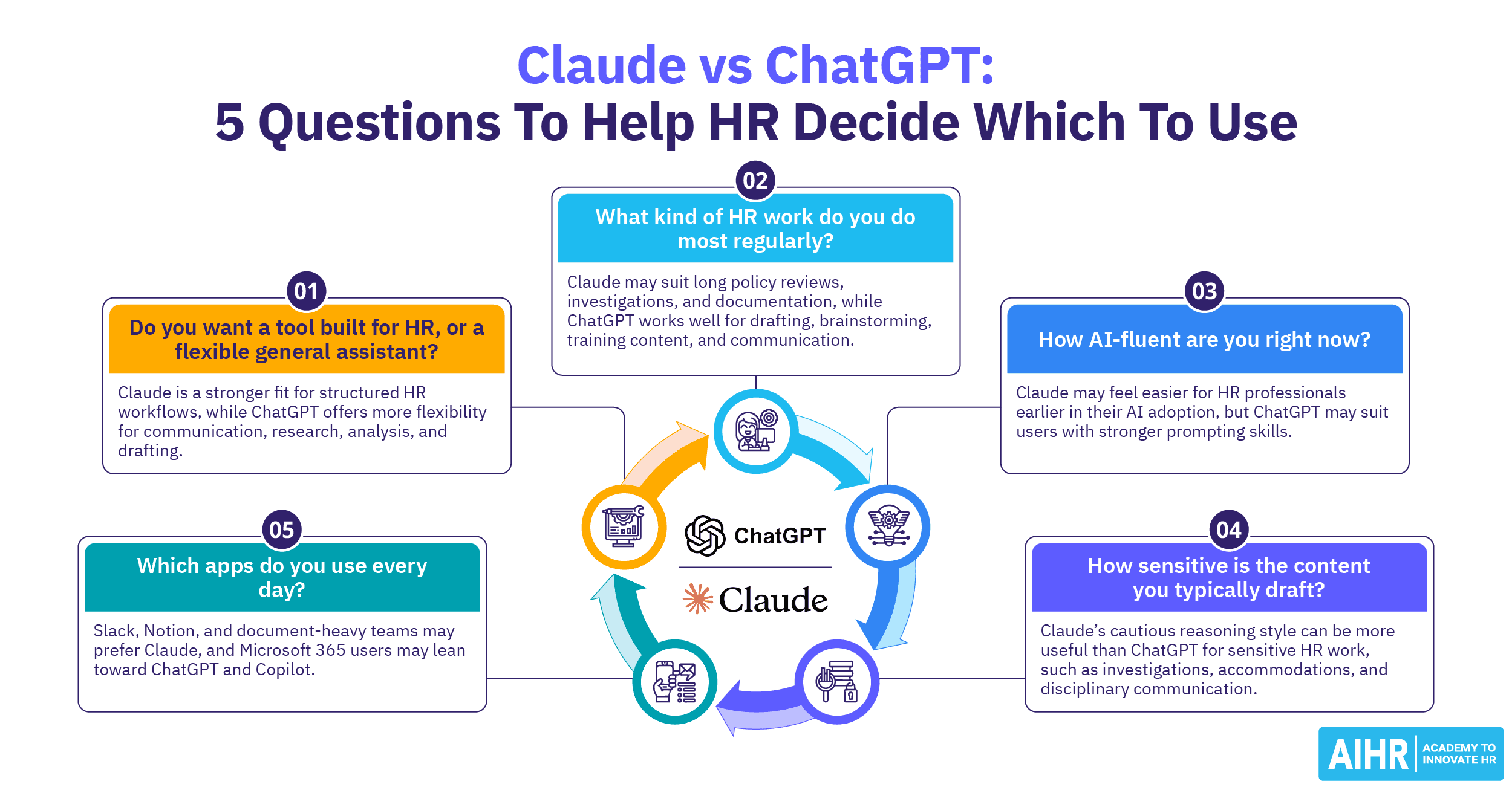
The honest answer is that most experienced HR professionals will benefit from using both tools, each in the contexts where it performs best. If your work is heavily weighted toward policy writing, employee relations, and sensitive documentation, Claude is likely to be your primary tool. If you move across a wide range of tasks, work with data regularly, and value speed and flexibility, ChatGPT may feel more at home in your workflow.
What matters most is not which tool wins the comparison, but how thoughtfully you integrate AI into your practice. The HR professionals who get the most out of these tools are those who treat them as capable assistants rather than infallible experts — always applying their own knowledge, ethics, and judgment to every output before it reaches an employee, a candidate, or a leadership team.
The generative AI landscape is moving fast, and both Claude and ChatGPT are improving rapidly. The best approach is to stay curious, keep experimenting, and ensure that the human element of human resources remains firmly in charge.