
Should You Specialize in HR? Here's What the Data Actually Shows
If you've been working in human resources for a few years, you've probably asked yourself whether it's time to go deeper into a specific area or continue building broad generalist experience. It's one of the most common career crossroads HR professionals face—and the answer, according to real labor market data, is more nuanced than a simple yes or no.
Research conducted by AIHR in collaboration with Revelio Labs, which analyzed large-scale labor market data to identify growing HR roles and in-demand skills, points to a clear conclusion: specializing in HR can significantly increase your earning power and improve your career prospects—but only if you choose the right specialization. Pick the wrong one, and you may find yourself competing with hundreds of other candidates for every opening, regardless of how attractive the salary looks.
Here's a breakdown of what the data reveals and how to use it to make a smarter career decision.
What Does It Mean to Specialize in HR?
Specializing in HR means moving beyond generalist responsibilities—like managing employee relations, coordinating onboarding, and handling basic compliance—and developing deep expertise in one particular domain. That could mean becoming an authority in compensation and benefits, HR technology implementation, talent acquisition strategy, people analytics, organizational development, or change management, among others.
A specialist typically commands a higher salary than a generalist at the same level because their knowledge is harder to replace. They're brought in to solve specific, often complex problems that a generalist workforce program simply isn't equipped to handle. This scarcity is exactly what drives higher pay—and it's also what makes choosing the right specialty so critical.
Should You Specialize in HR or Stay a Generalist?
The case for staying a generalist is real. Generalists are versatile, employable across industries, and valuable in smaller organizations where one person needs to handle many functions. But generalist roles also tend to attract a large pool of applicants, which can suppress salary growth and make advancement harder over time.
Specialization, by contrast, positions you in a smaller, more defined talent pool. When demand for a role outpaces the supply of qualified candidates, employers are more willing to negotiate on salary, offer remote flexibility, and invest in your continued development. The labor market data confirms this dynamic is very much at play in certain HR niches right now—while in others, even high salaries haven't created the wide-open opportunity many professionals assume they would.
HR Specialist Roles Currently in Demand
Not all HR specializations are created equal. According to the AIHR and Revelio Labs analysis, some of the most favorable roles in terms of candidate-to-opening ratios include the following areas:
- HR Technology: As organizations continue adopting HRIS platforms, workforce management tools, and AI-driven recruiting software, the need for HR professionals who can evaluate, implement, and optimize these systems has surged. Yet relatively few HR practitioners have developed technical fluency in this area, making it one of the least saturated specializations on the market.
- People Analytics: The ability to interpret workforce data, model turnover risk, measure the ROI of HR programs, and present insights to executive leadership is increasingly in demand. Organizations want HR professionals who speak the language of data—and finding them is still a genuine challenge for most hiring teams.
- Change Management: As businesses restructure, adopt new technologies, and navigate post-pandemic workforce shifts, change management specialists have become critical. This role requires a blend of organizational psychology, communication strategy, and project management that few HR professionals have formally developed.
These specializations share a common trait: the skills required are specific enough that they filter out most general applicants, creating a smaller, more competitive pool where qualified candidates have real leverage.
Why High Pay Doesn't Always Mean the Role Is Easy to Land
One of the most important insights from the AIHR data is that a high salary figure can be misleading. Some senior HR roles—Chief Human Resources Officers, Senior HR Business Partners at large enterprises, and Director-level talent management positions—offer very strong compensation packages. But they also attract enormous numbers of applicants, sometimes hundreds per opening.
This means the real opportunity isn't just about chasing the highest-paying title. It's about finding the intersection of strong pay and lower competition. Roles in HR tech, analytics, and change management tend to sit squarely in that intersection right now—making them strategically smarter targets for professionals who want to move up without fighting through an overcrowded field.
Why the Type of Work Matters More Than the Job Title
Job titles in HR vary wildly across organizations. One company's "HR Business Partner" might be doing deep organizational design work; another company's HRBP might be handling administrative tasks with a fancier label. This is why career experts consistently recommend focusing on the type of work you're doing and the skills you're building rather than the title you're chasing.
If your day-to-day involves data analysis, technology configuration, or leading organizational change initiatives, you're building credentials that transfer across titles and industries. That's the kind of experience that makes you genuinely competitive in a specialized market—not just someone with the right job title on a resume.
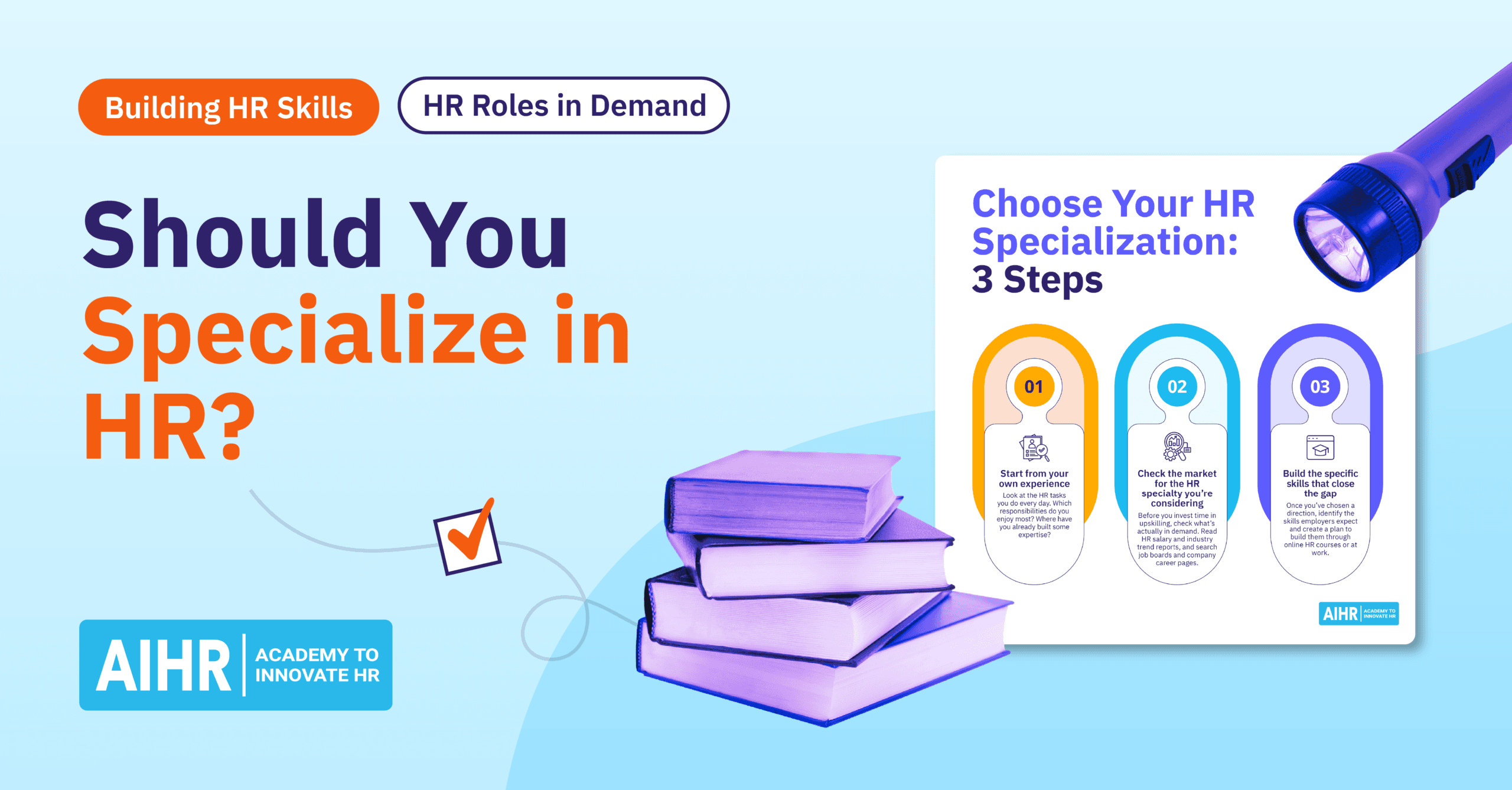
3 Steps to Choose the Right HR Specialization for You
If you're ready to narrow your focus, here's a practical framework for making a deliberate choice:
- Audit your existing experience: Look honestly at what you've spent the most time doing in your current and past roles. Which tasks energized you? Where have colleagues or managers recognized your strongest contributions? Your ideal specialization is often already visible in the work you gravitate toward naturally.
- Research the candidate-to-opening ratio, not just the salary: Before committing to a specialization, investigate how competitive the job market is in that niche. High average salaries are attractive, but they mean little if thousands of candidates are applying for the same small number of openings. Look for areas where demand is growing faster than the talent supply.
- Build skills proactively before making the move: The most credible specialists don't wait until they have a new job title to develop expertise—they start learning before the transition. Whether that means completing a certification in people analytics, volunteering to lead an HRIS implementation at your current organization, or taking on a change management project, demonstrable experience matters far more than credentials alone.
The Bottom Line on HR Specialization
The salary data makes a compelling case for specializing in HR—but it also comes with an important caveat. The payoff is real only when you choose a specialization where qualified candidates are genuinely scarce. HR technology, people analytics, and change management currently represent some of the strongest opportunities in this regard, combining solid compensation with far less crowded applicant pools than traditional senior HR roles.
If you're at a career inflection point, the smartest move isn't necessarily to chase the highest salary or the most prestigious-sounding title. It's to find the niche where your skills are rare, the demand is growing, and the competition hasn't yet caught up—and then invest deliberately in making yourself the obvious candidate.