
Why AI in Workforce Planning Is No Longer Optional
The predictive workforce analytics market is projected to more than triple, reaching $11.2 billion by 2035. That number tells a clear story: organizations are betting big on AI-powered workforce planning. But investment alone does not guarantee results. As budgets grow, so does the pressure on HR leaders to demonstrate concrete, measurable returns on that spending.
The question is no longer whether to adopt AI in strategic workforce planning. It is how to adopt it in a way that actually moves the needle on cost, capacity, skills availability, and overall business performance. This article breaks down exactly how HR leaders can make that happen.
What Is AI in Strategic Workforce Planning?
AI in strategic workforce planning refers to the use of machine learning, predictive analytics, and intelligent automation to help organizations anticipate and respond to workforce needs. Rather than relying on historical headcount data and manual spreadsheets, AI tools can analyze vast datasets to surface patterns, forecast talent gaps, model different business scenarios, and recommend actions before problems emerge.
At its core, AI-enabled workforce planning shifts HR from a reactive function into a proactive strategic partner. It gives leaders the ability to ask better questions: What skills will we need in 18 months? What happens to our workforce if we enter a new market? Where are our highest attrition risks, and what is the cost of doing nothing about them?
Where AI Creates the Most ROI in Workforce Planning
Not every AI application delivers equal value. HR leaders who want to maximize ROI need to focus their investment on the areas where AI has the strongest track record of driving measurable outcomes.
Demand and Capacity Forecasting
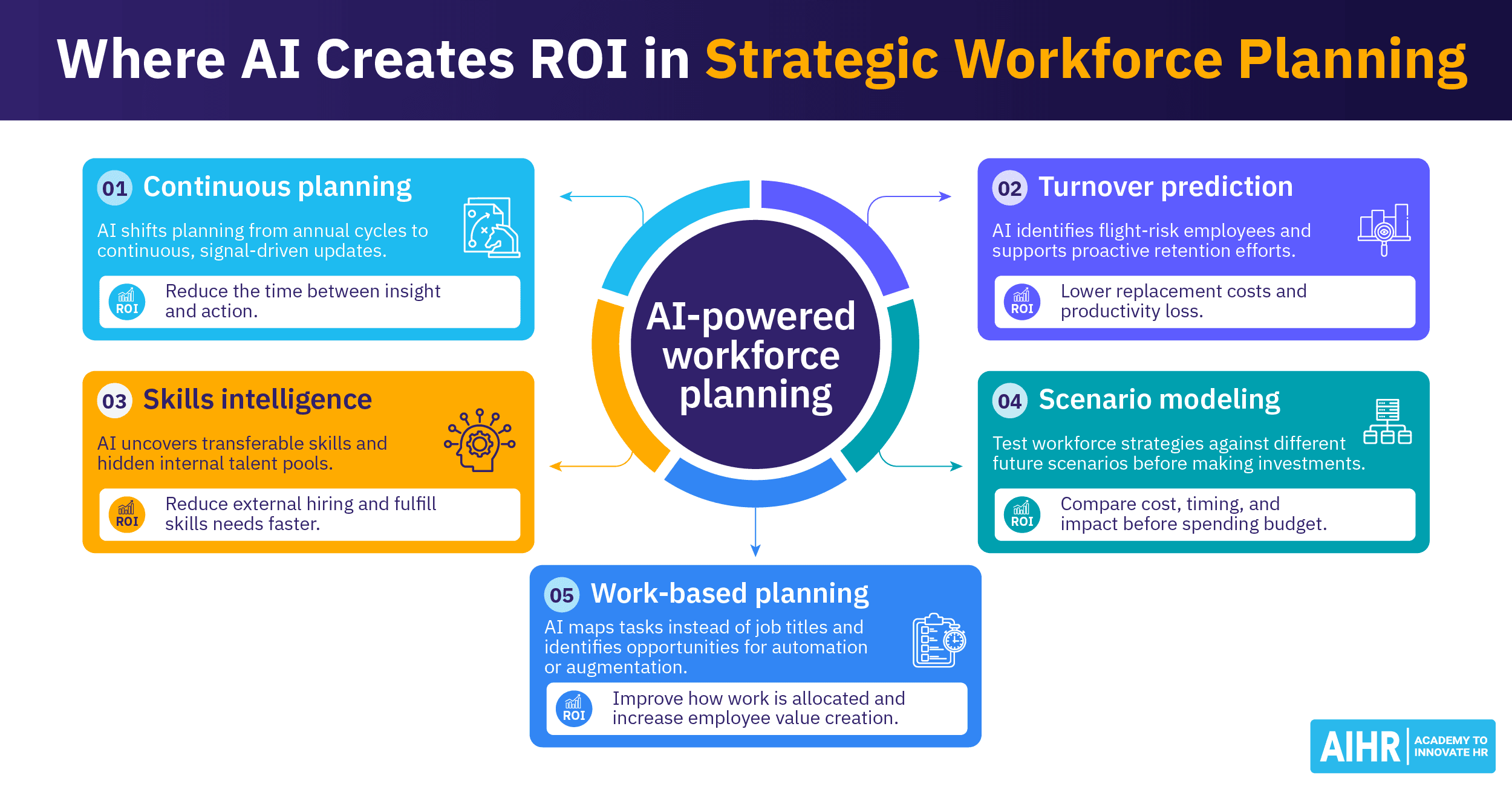
AI can analyze business growth data, seasonal trends, project pipelines, and external labor market signals to predict future workforce needs with far greater accuracy than traditional methods. More accurate forecasting reduces the cost of over-hiring and the operational drag of being understaffed. When leaders know what is coming, they can act earlier and smarter.
Skills Gap Identification
One of the most valuable applications of AI in workforce planning is its ability to map existing employee skills against future business requirements. By identifying gaps before they become critical, organizations can prioritize upskilling, reskilling, or targeted hiring well in advance. This is significantly less expensive than emergency recruitment or productivity losses caused by skill shortages.
Attrition Prediction and Retention
AI models can identify employees at risk of leaving based on engagement signals, compensation benchmarks, career trajectory patterns, and more. Early intervention is far cheaper than replacement. Studies consistently show that replacing an employee can cost anywhere from 50% to 200% of their annual salary. Reducing preventable attrition is one of the most direct paths to a strong AI ROI.
Scenario Planning and Decision Support
Strategic decisions — entering new markets, launching new product lines, restructuring teams — carry significant workforce implications. AI-powered scenario modeling allows HR leaders to simulate different futures and evaluate the workforce costs and risks associated with each option. This type of decision support reduces costly mistakes before they happen.
How to Measure the ROI of AI in Strategic Workforce Planning
ROI does not materialize automatically. It requires HR leaders to establish clear baselines before implementation and track the right metrics consistently after. Without a before-and-after comparison, it is nearly impossible to attribute improvements to AI specifically.
Key Metrics to Track
- Time-to-fill and cost-per-hire: Measure whether AI-assisted forecasting and talent pipeline building is reducing recruitment timelines and costs.
- Attrition rates: Track voluntary turnover before and after AI-driven retention programs are introduced.
- Skills gap closure rate: Monitor how quickly identified skill gaps are being addressed through learning programs or hiring.
- Workforce planning cycle time: Assess whether AI tools are helping HR teams produce workforce plans faster and with less manual effort.
- Forecast accuracy: Compare AI-generated workforce demand forecasts against actual hiring needs over time to validate model reliability.
- Business outcome alignment: Track whether workforce decisions informed by AI are correlating with improved team performance, project delivery, or revenue growth.
The key is to tie each AI use case back to a specific business problem with a defined cost or value. Vague claims about efficiency do not hold up in boardroom conversations. Numbers do.
6 Steps HR Leaders Can Take to Maximize AI ROI
- Start with a clear business problem. Do not deploy AI for its own sake. Identify a specific, costly workforce challenge — high attrition, slow hiring, skill shortages — and work backward to the right AI solution.
- Establish baselines before you begin. Capture current performance data across your target metrics so you have a genuine point of comparison once AI tools are in place.
- Invest in data quality. AI is only as good as the data it learns from. Audit your HR data sources for completeness, consistency, and accuracy before expecting reliable outputs.
- Build AI literacy across the HR function. HR teams do not need to become data scientists, but they do need to understand how to interpret AI outputs, spot limitations, and translate insights into action.
- Create feedback loops. AI models improve over time — but only when practitioners flag errors, validate predictions, and feed results back into the system.
- Communicate ROI in business language. Translate workforce analytics outcomes into financial and operational terms that resonate with finance and executive leadership. Cost savings, revenue enablement, and risk reduction speak louder than technical metrics.
The Bottom Line for HR Leaders
AI in strategic workforce planning holds genuine, substantial potential — but that potential only converts to ROI when HR leaders treat it as a strategic capability rather than a technology purchase. The organizations that will see the strongest returns are those that connect AI use cases to measurable business outcomes, build the internal skills to act on insights, and consistently demonstrate the value of data-driven people decisions.
The workforce analytics market is growing because the need is real. The HR leaders who rise to meet that need — with rigor, clarity, and a relentless focus on outcomes — will not just prove the ROI of AI. They will use it to become irreplaceable strategic partners to their businesses.