
Why Performance Review Phrases Matter More Than You Think
Performance review phrases are among the most searched HR resources on the internet, and for good reason. Managers across every industry face the same challenge: finding the right words to give feedback that actually motivates employees rather than deflating them. Yet according to Gallup, only 2% of Fortune 500 CHROs strongly agree that their performance management system genuinely inspires better performance. That statistic reveals something important — the problem is rarely about which words you choose. It is about the approach and the intent behind how those words are used.
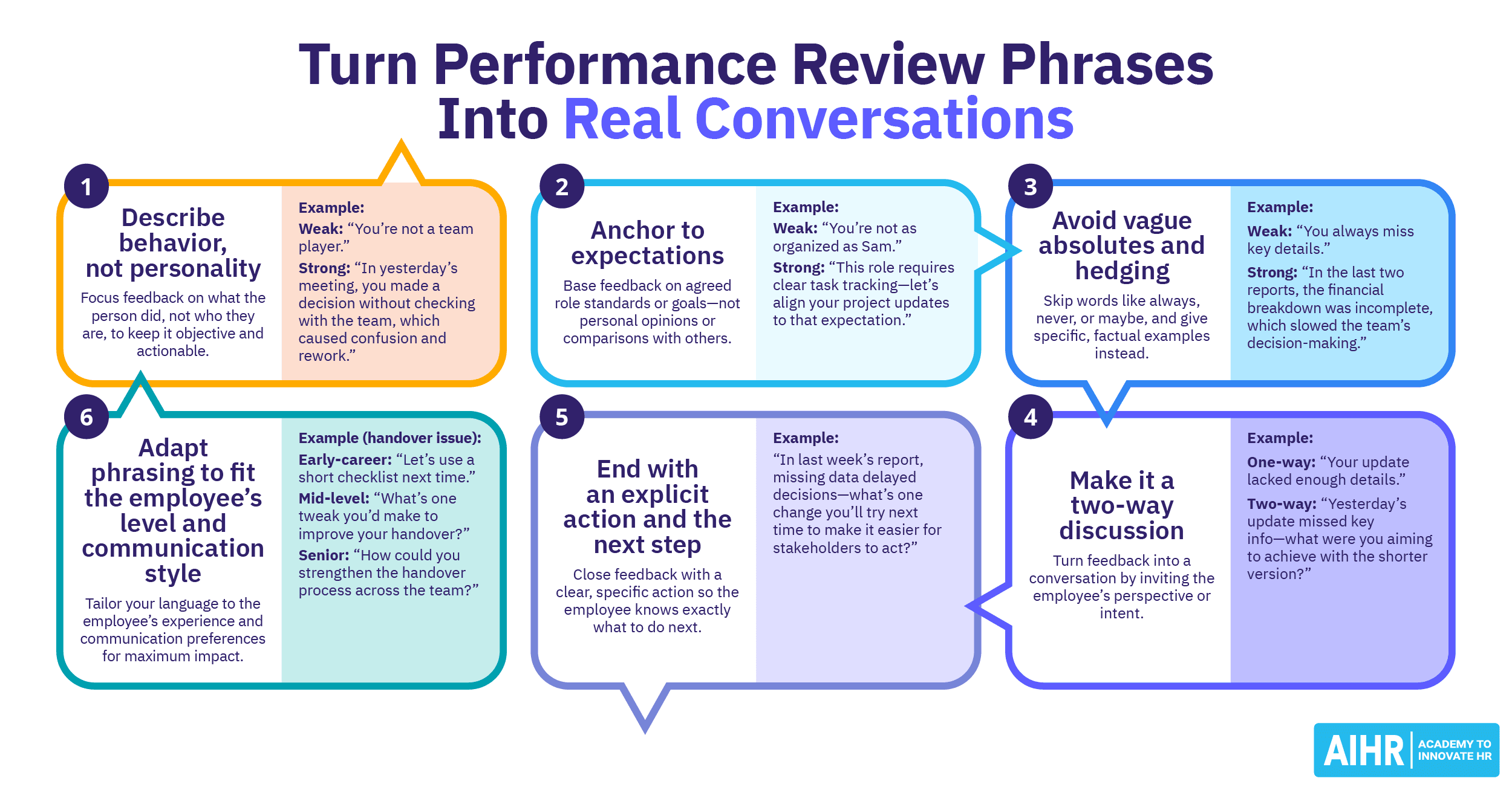
Copy-and-paste feedback can still be effective, but only when it meets three essential conditions. First, it must be behavior-based, meaning it ties feedback directly to observable actions rather than vague personality traits. Second, it must be used within a two-way conversation where employees feel heard, not evaluated from a distance. Third, it must be followed by a clear, agreed-upon next step. Without these elements, performance reviews become one-sided judgments that employees endure rather than conversations that help them grow.
As continuous feedback loops, frequent check-ins, and ongoing coaching conversations become the new standard in modern workplaces, managers need language that feels intentional, human, and actionable throughout the entire year — not just during formal appraisal season.
What Are Performance Review Phrases?
Performance review phrases are structured statements that managers use to communicate observations about an employee's work, behavior, and development. They serve as a starting point — a framework for delivering feedback in a clear, consistent, and professional way. Good performance review phrases are specific, grounded in real examples, and focused on what an employee has done and what they could do differently or better.
They fall into several broad categories, including phrases for communication skills, teamwork, problem-solving, leadership, productivity, adaptability, and areas that need improvement. The best phrases are never a substitute for genuine conversation. Instead, they give managers a reliable vocabulary so that feedback is equitable, structured, and meaningful across the entire organization.
The 4 Core Components of Effective Performance Feedback
Before diving into specific phrases, it helps to understand what makes feedback effective in the first place. Strong performance review language consistently includes four components.
- Specificity: Instead of saying "you did a great job," effective feedback identifies the exact behavior or outcome — for example, "you delivered the Q3 client report two days ahead of schedule, which allowed the team to prepare more thoroughly for the presentation."
- Impact: Feedback should explain why the behavior matters, connecting individual actions to team or business outcomes.
- Balance: Acknowledging both strengths and development areas shows employees a complete, honest picture of their performance.
- Forward focus: The most motivating feedback ends with a direction, whether that is a goal, a resource, or a follow-up conversation date.
192 Performance Review Phrases Across Key Categories
Below is an overview of performance review phrases organized by competency, along with follow-up questions that transform each statement into a genuine coaching dialogue.
Communication Skills
Strong communicators are the backbone of any high-performing team. When recognizing communication strengths, managers might use phrases such as: "You consistently present complex information in a way that is easy for diverse audiences to understand," or "Your written updates are clear, timely, and help the whole team stay aligned." For employees who need development in this area, consider: "There are moments when your message gets lost in detail — let's work on identifying your core point before expanding further."
Follow-up questions to ask: "How do you prepare before sharing complex updates with the team?" and "What do you think gets in the way of clear communication in high-pressure situations?"
Teamwork and Collaboration
Collaboration phrases should reflect both contribution and impact on others. Positive examples include: "You actively support your colleagues during peak periods, which has contributed directly to the team meeting its targets," and "You bring a spirit of generosity to group projects that raises the energy of those around you." For development needs: "There are times when working more closely with cross-functional partners earlier in a project would reduce rework and improve outcomes."
Follow-up questions: "What does effective collaboration look like to you?" and "Where do you feel most challenged when working across different teams?"
Problem-Solving and Initiative
Recognizing proactive behavior encourages more of it. Try phrases like: "You identified a workflow bottleneck before it became a critical issue and proposed a solution that saved the team significant time." For areas of growth: "I'd love to see you take more ownership when challenges arise in your scope, rather than waiting for direction." Follow-up questions: "Walk me through how you approached a recent problem you solved independently," and "What obstacles feel biggest when you try to take initiative?"
Leadership and Influence
Even employees without formal titles can demonstrate leadership. Strong phrases include: "You have become a go-to resource for newer team members, and your mentorship has visibly accelerated their confidence." Development-oriented feedback might read: "Building your ability to give direct feedback to peers will strengthen both your own leadership presence and team performance." Follow-up: "How do you define leadership in your current role?" and "What kind of support would help you step more fully into a coaching role with your peers?"
How to Use Performance Review Phrases in a Conversation
Effective managers understand that phrases are starting points, not scripts. The goal of a performance review conversation is to create psychological safety so that employees can reflect honestly on their own performance. Before the meeting, share the phrases you plan to use so employees are not caught off guard. During the conversation, ask follow-up questions that invite their perspective. After the meeting, document agreed-upon next steps and schedule a follow-up to ensure accountability without surveillance.
One practical structure many managers rely on is the SBI model — Situation, Behavior, Impact. It works as follows: describe the specific situation, name the behavior you observed, and explain the impact it had. When combined with a follow-up question, SBI transforms a static evaluation phrase into a dynamic coaching moment.
How HR Can Coach Managers to Use Feedback More Effectively
HR teams play a critical role in helping managers move from box-checking to genuine development conversations. This means offering manager training on feedback techniques, providing phrase banks as guidance rather than mandated scripts, and modeling the behavior HR wants to see. Managers who receive coaching on how to give feedback are significantly more likely to conduct reviews that employees find fair, motivating, and useful.
HR can also create accountability by building follow-up questions directly into review templates and by analyzing review data over time to spot patterns — such as whether certain groups consistently receive less specific feedback, which may signal bias in the process.
Final Thoughts
Performance review phrases, when used thoughtfully, are powerful tools for building trust, clarity, and momentum between managers and employees. The 192 examples covered across communication, teamwork, problem-solving, and leadership offer a rich starting point. But the real value comes from pairing each phrase with genuine curiosity, a follow-up question, and a commitment to action. That is when feedback stops being an annual obligation and starts becoming one of the most powerful levers for employee growth and organizational performance.