
Why Choosing the Right Learning and Development Course Matters
Not every learning and development course is created equal, and a high rating alone is rarely enough to justify your time and money. The best learning and development courses are the ones that match exactly where you are in your HR career and where you want to go next. Whether you are new to L&D, looking to validate years of experience, or eager to apply sharper skills in your current role, the right course depends on fit — not just popularity.
With hundreds of options now available across online platforms, professional associations, and certificate programs, the challenge is no longer finding a course. The challenge is finding the right one. This guide breaks down what makes an L&D course worth your investment, explores ten strong options organized by career and skills goal, and gives you a practical framework for making your decision.
What Makes a Learning and Development Course Worth It?
Before comparing specific programs, it helps to understand the criteria that separate a truly valuable L&D course from one that simply looks impressive on a website. A course worth your time should do at least one of three things clearly: help you explore a new skill area, validate your existing expertise against a recognized standard, or build applied capabilities you can use in your job immediately.
Beyond that core purpose, consider the credibility of the provider, the structure of the learning experience, and the type of output you receive at the end. An exam-based credential signals professional recognition to employers. A project-based certificate program signals practical, job-ready skills. A short marketplace course signals curiosity and willingness to learn. Each has a legitimate place in your development journey depending on your current goal.
Best Learning and Development Courses by Goal
Organizing your search by goal rather than by format or price makes it far easier to narrow down your options. Here is how the ten best learning and development courses break down across three primary goals.
Courses to Explore L&D
If you are new to learning and development or want to test whether a particular topic is the right direction for you, short marketplace courses are ideal. Platforms like Coursera, LinkedIn Learning, and Alison offer accessible, low-commitment programs that cover foundational L&D concepts including instructional design, employee training strategy, and learning technology. These courses are typically self-paced, affordable, and carry enough credibility to demonstrate initiative on a resume or LinkedIn profile.
The key advantage of starting here is flexibility. You can sample multiple subjects, identify what resonates with your interests, and build a clearer picture of the specialization you want to pursue before committing to a longer, more expensive program.
Courses to Validate Your Expertise
When professional recognition matters — whether for a promotion, a career change, or simply demonstrating competence to a new employer — exam-based credentials from established bodies carry the most weight. The Association for Talent Development (ATD) and the Chartered Institute of Personnel and Development (CIPD) are two of the most recognized names in this space.
ATD's Certified Professional in Talent Development (CPTD) and Associate Professional in Talent Development (APTD) credentials are widely respected in the United States and internationally. CIPD qualifications, particularly at Level 5 and Level 7, are considered benchmark standards in the UK and across many global HR teams. Both require you to demonstrate knowledge and experience against a defined competency framework, which is precisely why they hold value in the eyes of hiring managers and HR leaders.
Courses to Build Applied Skills
For HR professionals who want to move from theory into practice, structured certificate programs are the most effective option. These programs are typically designed around real-world scenarios, strategy frameworks, and hands-on projects that mirror what L&D practitioners actually do on the job. Topics such as learning and development strategy, instructional design, learning analytics, and performance consulting are commonly covered in depth.
Programs from specialized HR education providers offer a particularly strong return on investment here because they are built specifically for HR and L&D professionals rather than adapted from generic business or management curricula. The result is content that is immediately relevant, applicable, and grounded in current HR practice.
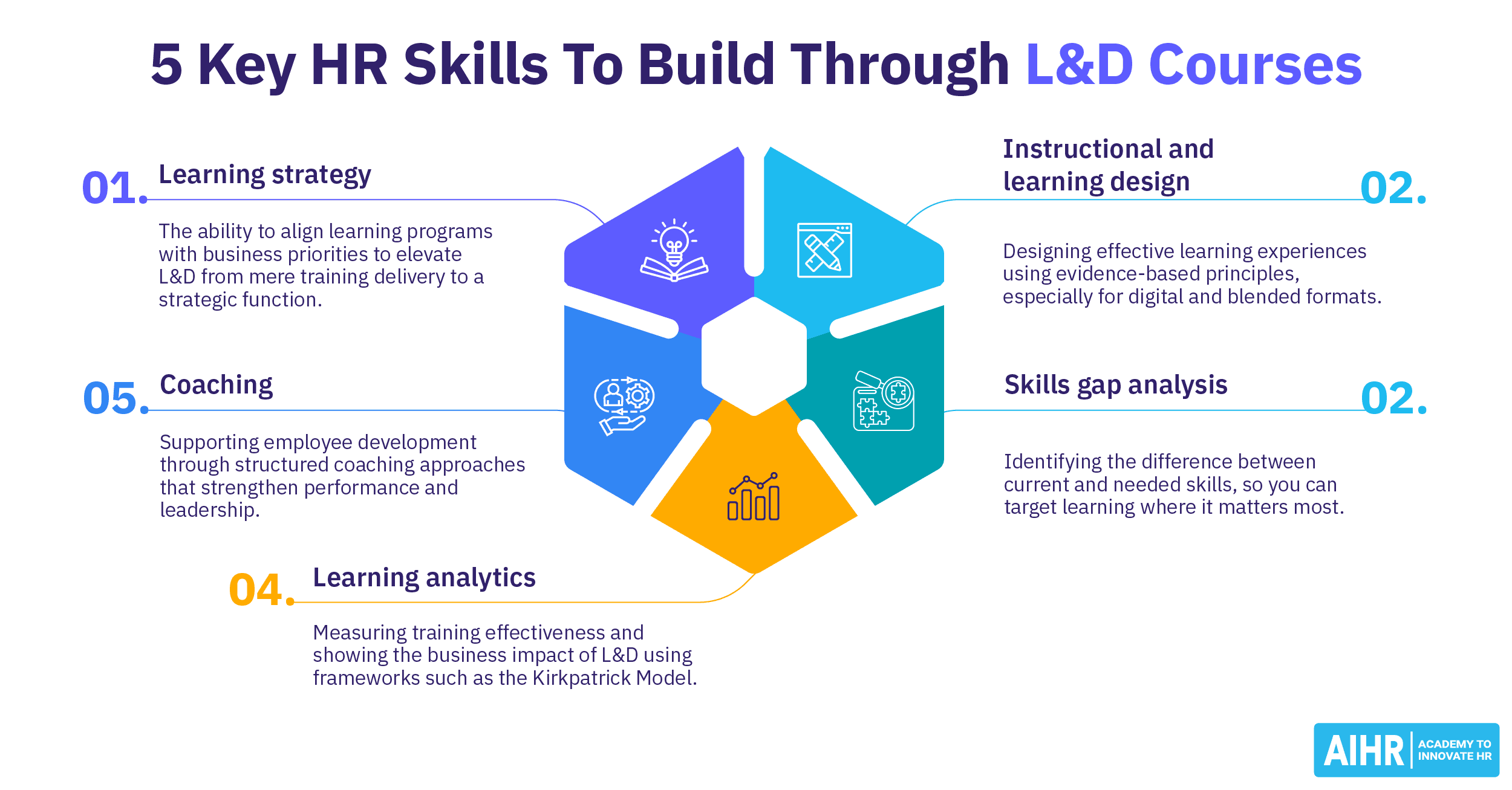
5 Key Skills the Best L&D Courses Should Build
Regardless of the program you choose, the strongest learning and development courses will help you develop a core set of capabilities that are consistently in demand across organizations of all sizes and industries.
- L&D strategy and alignment: The ability to connect learning programs directly to business goals, workforce planning, and organizational performance rather than designing training in isolation.
- Instructional design: A working knowledge of how adults learn and how to design engaging, effective learning experiences across various formats including e-learning, workshops, and blended programs.
- Learning analytics: The skill to measure the impact of L&D initiatives using data, evaluate return on investment, and use insights to continuously improve programs.
- Stakeholder management: The ability to collaborate with business leaders, managers, and subject matter experts to identify learning needs and secure buy-in for development initiatives.
- Technology fluency: Familiarity with learning management systems (LMS), authoring tools, and emerging learning technologies including AI-powered platforms that are reshaping how organizations deliver development at scale.
How to Choose the Right L&D Course for You
The most important step before comparing any specific course is to be honest about your current goal. Ask yourself whether you are trying to explore the field, earn a credential that signals expertise, or develop skills you can apply right now. Your answer to that question should drive every other decision.
From there, consider your experience level. Entry-level HR professionals will benefit most from foundational programs and short courses that build vocabulary and basic frameworks. Mid-career practitioners are better served by applied certificate programs or credential preparation that validates what they have already built. Senior L&D professionals looking to stay current may find the most value in focused short courses on emerging topics like AI in learning, skills-based organization design, or advanced analytics.
Budget and time are also real factors. A multi-month certificate program is a meaningful investment. If you are unsure, use a short marketplace course to test the topic first before committing. The goal is not to collect credentials — it is to build the skills your next HR role actually needs and to have credible proof that you have done so.
Final Thoughts
Learning and development is one of the fastest-growing specializations within HR, and the demand for skilled L&D practitioners continues to rise as organizations prioritize workforce capability, skills agility, and continuous learning culture. Investing in your own development as an L&D professional is not just good career strategy — it is essential for staying relevant in a field that evolves quickly. Choose a course that matches your goal, commit to applying what you learn, and treat your own growth with the same intentionality you would bring to any learning program you design for others.