
Which Degree Is Best for HR? A Complete Guide
People come into Human Resources from all sorts of backgrounds. Some study HR directly, others arrive through psychology, business, or law, and many cross over from adjacent roles in recruitment, administration, or operations. That variety reflects something important: there is no single best degree for HR. The function sits at the intersection of business strategy, human psychology, employment law, and people data, which means several academic paths can prepare you well for a rewarding career in the field.
The right choice depends on where you are starting from, the kind of HR work that interests you most, and how far you want to progress in your career. This guide walks through the degrees most relevant to an HR career, what each one emphasizes, the roles each tends to lead to, and how formal degrees compare with other ways of building HR skills — such as online HR learning and professional certifications.
Do You Need a Degree to Work in HR?
The short answer is: not necessarily, but it helps. Many entry-level HR roles — such as HR assistant, recruitment coordinator, or HR administrator — do not formally require a degree. Employers often prioritize communication skills, attention to detail, and a genuine interest in working with people over academic credentials at the junior level.
However, as you move up into generalist, business partner, or specialist roles, employers increasingly look for either a relevant degree or evidence of structured professional development. Senior HR leadership positions — such as HR Director or Chief People Officer — almost universally expect a combination of advanced qualifications and significant experience. A degree can accelerate that journey, especially if you choose one that aligns with the HR specialism you want to pursue.
The Main Degree Fields for HR
Because HR touches so many disciplines, several degree subjects provide a strong foundation. Here are the most relevant fields and what each brings to the table.
Human Resources Management
A dedicated HR Management degree is the most direct route into the profession. These programmes cover core HR topics including talent acquisition, learning and development, compensation and benefits, employee relations, and HR strategy. Many also incorporate employment law, organisational behaviour, and people analytics. Graduates typically enter HR coordinator or HR generalist roles and can progress quickly because they already understand the language and frameworks of the function. Some universities offer specialised pathways within HR degrees, such as organisational psychology or workforce planning, which can give you an early edge in niche areas of the profession.
Business Administration
A Business Administration or Business Management degree is one of the most common backgrounds for HR professionals, particularly those who move into HR business partner or strategic HR leadership roles. These programmes develop a broad understanding of how organisations operate, covering finance, operations, marketing, and strategy alongside modules in people management. HR professionals with a business background often find it easier to speak the language of senior leadership and to align HR initiatives with commercial objectives — a skill that becomes increasingly important at managerial level.
Psychology
Psychology is another highly relevant degree for HR, especially for those interested in areas such as talent assessment, organisational development, employee wellbeing, or learning design. Studying psychology gives you a deep understanding of human behaviour, motivation, cognitive bias, and group dynamics — all of which are directly applicable to how organisations attract, retain, and develop people. Industrial-organisational psychology, in particular, bridges the gap between psychological research and workplace application. Many HR professionals with psychology backgrounds move into specialist roles in talent management, culture, or people analytics.
Law
Employment law is one of the most complex and consequential areas that HR professionals navigate. A law degree — or even a business degree with a strong employment law component — can be a significant advantage, particularly in employee relations, HR compliance, or HR consulting. HR professionals with legal training are well placed to handle disciplinary processes, manage redundancy situations, interpret contracts, and advise line managers on complex people issues. While a full law degree is not necessary for most HR roles, a solid grounding in legal principles is a recurring theme in HR job descriptions at mid-to-senior level.
Sociology and Organisational Studies
Degrees in sociology, organisational studies, or social sciences develop critical thinking about how institutions work, how power operates within organisations, and how social structures influence behaviour at work. These disciplines are particularly well-suited for HR professionals interested in diversity, equity and inclusion, culture change, or workforce strategy. Graduates from these fields often bring a more systemic view of workplace dynamics, which is increasingly valued as organisations grapple with complex cultural challenges.
HR Degrees vs Other Learning Options
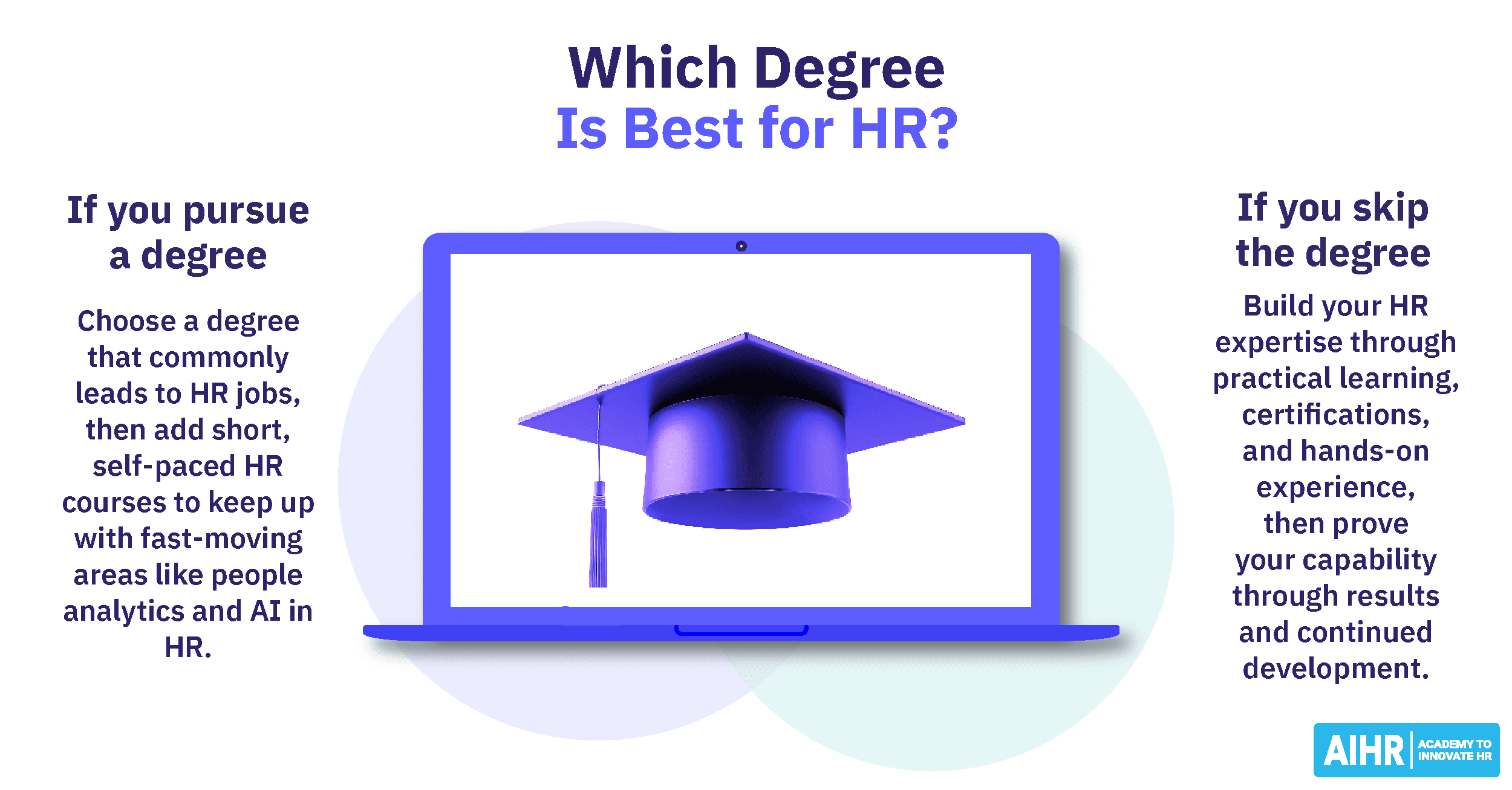
A university degree is not the only way to build the knowledge and credentials needed for an HR career. Professional certifications and online HR learning have become increasingly credible alternatives and complements to formal academic study.
Professional HR certifications — such as those offered by the CIPD in the UK, SHRM in the United States, or through specialist online HR academies — provide focused, practical training that is directly aligned with what employers need. They are often faster to complete than a degree, more affordable, and can be pursued alongside full-time work. For career changers or experienced professionals looking to formalise their knowledge, these routes offer an efficient path to recognised credentials.
Online HR learning platforms go a step further by offering modular, skill-specific programmes that can be stacked over time. These are particularly valuable for HR practitioners who want to develop expertise in fast-moving areas like people analytics, HR technology, or strategic workforce planning — topics that traditional degree programmes may not cover in sufficient depth or with sufficient currency.
That said, a degree and ongoing professional learning are not mutually exclusive. Many of the most effective HR professionals combine a relevant degree with continuous investment in specialist skills throughout their careers.
How to Choose the Right Path for You
Choosing the right educational path for an HR career comes down to a few key questions. First, where are you in your career? If you are just starting out and have the time and resources for full-time study, a dedicated HR or business degree gives you a strong foundation and signals commitment to employers. If you are already working in HR or making a career change, professional certifications and online learning will likely deliver more value more quickly.
Second, what kind of HR work interests you? If you are drawn to the strategic side of HR — workforce planning, organisational design, or HR leadership — a business or HR management degree may be the best fit. If you are more interested in the human side — wellbeing, culture, talent assessment — a psychology or sociology background will serve you well. If employment law and compliance appeal to you, a legal grounding will set you apart.
Third, how far do you want to go? For those aiming at the most senior HR leadership roles, a postgraduate qualification — such as an MBA or a master's degree in HR or organisational psychology — can be a meaningful differentiator later in your career, particularly when combined with substantial practical experience.
Ultimately, the HR profession is broad enough and diverse enough that many different academic backgrounds can lead to a successful and fulfilling career. The most important investment you can make is not necessarily in a specific degree, but in building a genuine understanding of people, organisations, and the business context in which HR operates — and continuing to develop that understanding throughout your career.