
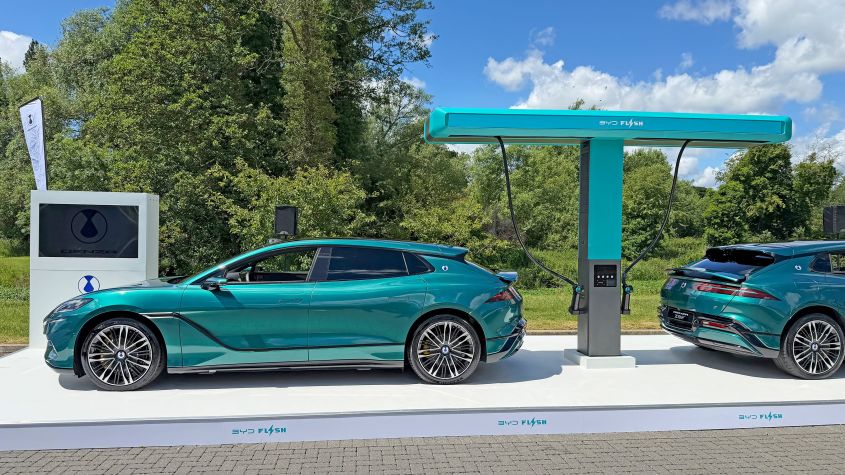
BYD Flash Charging: The Technology That Could Change How the World Charges Electric Cars
Range anxiety has long been the most stubborn obstacle standing between the average driver and an electric vehicle. But what if charging your EV took no longer than stopping for a coffee? That is the promise at the heart of BYD Flash Charging, a next-generation ultra-rapid charging technology that claims to take a compatible electric car from 10 to 97 per cent battery capacity in just nine minutes. We attended a live demonstration of the system and sat down with Diego Pareschi, BYD's head of EV charging strategy, to get every question answered — from how the technology actually works to when and where UK drivers can expect to use it.
What Is BYD Flash Charging?
BYD Flash Charging is the Chinese automaker's proprietary ultra-high-power charging solution, designed to work in close harmony with BYD's own battery chemistry and vehicle electronics. Unlike a conventional rapid charger, which is largely limited by the car's onboard charging system, BYD Flash Charging is an end-to-end ecosystem — the charger, the cable, the battery management system, and the vehicle architecture are all engineered together to push power at extraordinary rates without compromising battery health or safety.
The headline figure is compelling: a charge from 10 to 97 per cent in approximately nine minutes. To put that in perspective, even the fastest public chargers available in the UK today — typically 150 kW to 350 kW units — would take the better part of 20 to 30 minutes to deliver a comparable result in most electric vehicles. BYD is talking about a meaningful, real-world leap forward, not an incremental improvement.
The Live Demo: What We Saw
Seeing is believing, and BYD put its money where its mouth is with a controlled live demonstration. A compatible BYD vehicle was connected to a Flash Charging unit under monitored conditions, and the results tracked closely with the company's published claims. The charging curve was notably flat compared to the steep taper-off that plagues most fast-charging sessions — the kind of drop-off that means you spend the last 20 per cent of a session waiting far longer than the first 20 per cent took.
What was equally impressive was how composed the process felt. There was no excessive heat emanating from the cable or the charge port, no alarming sounds, and no dramatic intervention from thermal management systems throttling the session. BYD attributes this to the liquid-cooled cable technology integrated into the charging hardware and to cell-level monitoring that adjusts power delivery in real time across every individual cell in the pack.
The Technology Behind the Speed
So how does BYD actually achieve this? According to Diego Pareschi, several layers of innovation converge to make Flash Charging possible.
- Ultra-high-voltage architecture: BYD's Flash Charging compatible vehicles operate on an 1,000-volt electrical architecture, which allows more power to be transferred at lower current levels. Lower current means less heat, which is the primary enemy of fast charging.
- Advanced battery chemistry: BYD's latest cell technology is engineered to accept charge at rates that would degrade conventional lithium-ion packs. The internal resistance of the cells has been significantly reduced, allowing electrons to flow in rapidly without generating damaging heat.
- Intelligent battery management: A sophisticated BMS monitors temperature and state of charge at the individual cell level, dynamically adjusting input to keep every cell in a safe operating window throughout the session.
- Liquid-cooled charging cables: The cable connecting the charger to the car circulates coolant internally, keeping connector temperatures safe even at peak power levels that would melt conventional copper cables.
BYD Flash Charging UK Rollout: When and Where?
For UK drivers, the obvious question is availability. Pareschi confirmed that BYD is actively working on bringing Flash Charging infrastructure to Britain, though he was measured about committing to hard dates. The rollout is expected to follow a phased approach, starting with flagship BYD dealerships and high-traffic motorway service areas before expanding to urban hubs and destination charging locations.
Compatibility will initially be limited to new BYD vehicles built on the brand's latest platform, so existing BYD owners should not expect a retrofit option. The vehicles and the chargers are too tightly integrated for a software update alone to unlock Flash Charging capability on older models.
How Much Will BYD Flash Charging Cost?
Pricing has not been confirmed in full for the UK market, but Pareschi indicated that BYD intends to position Flash Charging as a premium but accessible service rather than a luxury add-on. The company is aware that ultra-rapid charging can command a significant cost-per-kWh premium at public networks, and it is reportedly in discussions with charging network partners to keep session prices competitive relative to the time saving on offer. Subscription or loyalty pricing tied to BYD vehicle ownership is also understood to be under consideration.
Does Ultra-Fast Charging Damage the Battery?
This is the question every EV sceptic asks first, and it is entirely reasonable. Pareschi addressed it directly, pointing to BYD's internal testing data which suggests that cells engineered specifically for Flash Charging retain well over 80 per cent of their original capacity after thousands of fast-charging cycles — a figure in line with or better than many conventional EVs after regular slow charging. The key, he stressed, is that the technology was designed holistically from the ground up. Retrofitting these charge rates onto an existing battery architecture would indeed cause degradation; building a battery to handle them from day one is a fundamentally different proposition.
What This Means for the Future of Electric Driving
BYD Flash Charging is not just a product launch — it is a statement of intent. If the technology scales as promised and the infrastructure arrives in meaningful numbers, it renders the charging-time objection to EV ownership largely obsolete. Nine minutes at a motorway service area is not a burden; it is a pit stop. Combined with BYD's aggressive pricing strategy on its vehicle lineup, Flash Charging could be one of the most significant accelerants for mass EV adoption the UK market has seen. The road ahead looks considerably faster than it did before.