
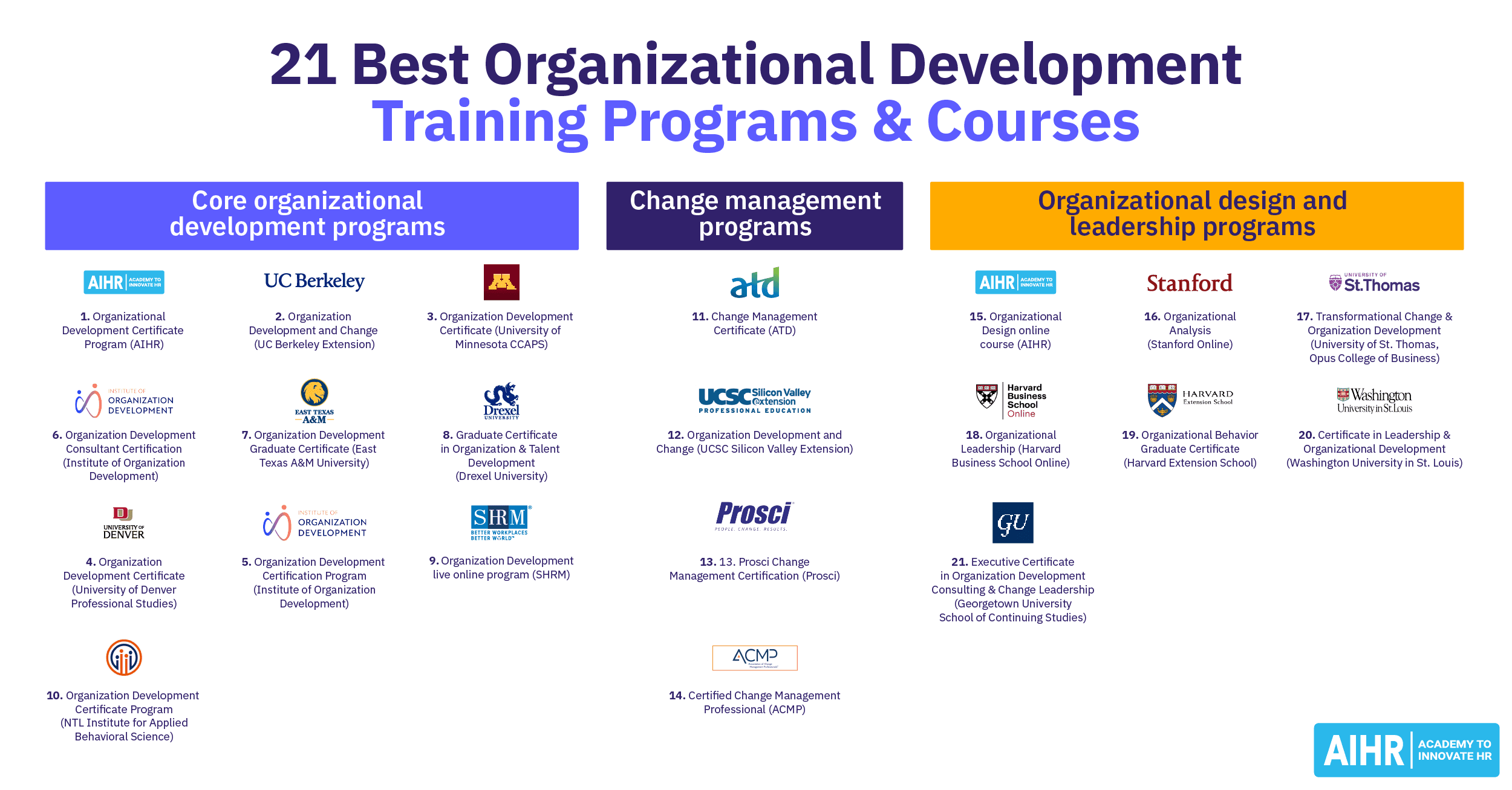
Why Organizational Development Training Matters
What separates companies that consistently grow from those that struggle to keep up? More often than not, the answer comes down to how effectively they develop their organizations from the inside out. Organizational development (OD) is the discipline that brings people, processes, and structure into alignment — and when done well, it drives measurable improvements in performance, culture, and long-term resilience.
For HR professionals, people managers, and OD specialists, investing in organizational development training is one of the most strategic career moves available. The right program gives you practical frameworks to diagnose problems, design interventions, lead change initiatives, and demonstrate real business impact. Whether you work in manufacturing, technology, healthcare, or the nonprofit sector, strong OD capabilities translate directly into results.
This guide breaks down the landscape of OD training and certifications — what they offer, why they matter, and how to choose the right one for your goals.
The Benefits of Organizational Development Training
Before exploring specific programs, it is worth understanding what OD training actually does for your professional development and for your organization. The benefits go well beyond adding a credential to your resume.
- Practical diagnostic skills: OD training teaches you how to assess organizational gaps, identify root causes of performance issues, and recommend targeted solutions. Rather than applying generic fixes, you learn to read the specific context of your organization and respond strategically.
- Change management expertise: Most organizational challenges involve navigating resistance, managing transitions, and sustaining momentum through uncertainty. OD programs equip you with proven change management methodologies that increase the likelihood of successful transformation.
- Stronger leadership influence: When you understand organizational systems and design, you become a more credible voice in strategic conversations. OD-trained professionals are better positioned to influence senior leadership and contribute to decisions that shape culture and direction.
- Career advancement: Earning a reputable OD certification boosts your professional credibility, expands your network, and opens doors to more senior HR roles, internal consulting positions, and external advisory opportunities.
- Organizational impact: Beyond personal growth, the skills you gain translate directly into better business outcomes — higher employee engagement, more effective teams, smoother change adoption, and stronger alignment between business strategy and people practices.
Types of Organizational Development Programs
The OD training landscape is broad, with options ranging from short self-paced online courses to multi-month university certificate programs. Understanding the categories available helps you match the right format to your current needs and learning preferences.
Core Organizational Development Programs
Core OD programs focus on foundational concepts including systems thinking, organizational diagnosis, intervention design, and data-driven decision-making. These programs are ideal for HR professionals who are new to the OD field or who want to formalize and deepen existing knowledge. They typically cover the full OD cycle — from entry and contracting through diagnosis, intervention, and evaluation — giving participants a complete toolkit for driving organizational change.
Many of these courses are offered by established institutions and professional associations, ensuring the content is grounded in both academic research and real-world practice. Formats vary widely, with some programs delivered entirely online with flexible scheduling, while others include live virtual workshops, cohort-based learning, or in-person intensives that allow for richer peer interaction and networking.
Change Management Programs
Change management is a critical subset of organizational development, and several programs focus specifically on this competency. These courses teach structured methodologies — such as Kotter's 8-Step Model, ADKAR, or Prosci frameworks — for planning and executing organizational change in ways that minimize disruption and maximize adoption.
Change management certifications are particularly valuable for professionals who lead large-scale transformation initiatives, technology implementations, mergers and acquisitions, or cultural shifts. Employers increasingly look for candidates who can demonstrate not just an understanding of change theory but hands-on capability in applying it under real conditions.
Organizational Design and Leadership Programs
These programs focus on the structural side of OD — how organizations are designed to support strategy, how roles and reporting relationships are configured, and how leadership behavior shapes organizational culture. Participants learn how to assess whether an organization's current design is fit for purpose and how to redesign structures when business needs evolve.
Leadership-focused OD programs often incorporate coaching, feedback, and behavioral science, recognizing that sustainable organizational change requires leaders who model the values and practices they want to see. These programs are well-suited for senior HR professionals, organizational consultants, and business leaders who want to develop more strategic capabilities.
How to Choose the Right OD Certification
With 21 programs available across different formats, price points, and learning objectives, choosing the right one requires honest reflection on a few key questions. What is your current level of OD knowledge? Are you looking for a credential that signals expertise to employers, or practical skills you can apply immediately? How much time and budget can you commit?
Short self-paced courses work well for professionals who need targeted upskilling without disrupting a busy schedule. Multi-month certificate programs from universities or professional associations carry more weight on a resume and typically offer deeper learning experiences, but they require a larger time investment. Some programs also offer continuing education credits or count toward broader HR certifications, which adds additional value.
It is also worth considering whether the program includes a community or alumni network. OD is a field where peer learning and professional relationships matter enormously, and access to a strong cohort or professional community can extend the value of a program well beyond the coursework itself.
Investing in OD Training Is Investing in Organizational Health
Organizations that prioritize OD capabilities consistently outperform those that treat people strategy as an afterthought. For HR professionals ready to move into more strategic roles — and for organizations serious about building adaptive, high-performing cultures — OD training and certification is one of the highest-return investments available. Whether you start with a foundational course or pursue a comprehensive certification, the skills you build will pay dividends across every stage of your career and every organization you touch.