
The Scale of 2026 Tech Layoffs Is Hard to Ignore
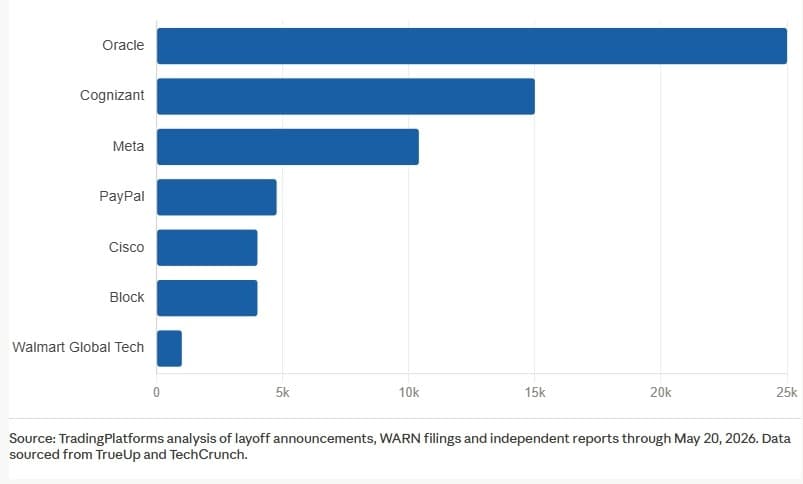
Since January 2026, at least 127,998 tech sector employees have lost their jobs, according to new research published by TradingPlatforms. That is not a rounding error — it is a workforce crisis playing out in real time, hitting engineers, customer support teams, content moderators, back-office professionals, and mid-level managers across some of the most profitable companies in the world.
What makes this wave of layoffs particularly striking is the stated reason behind so many of them. Roughly 60% of the total recorded job cuts — approximately 76,979 positions — have been directly linked to AI adoption, automation investment, and the rapid buildout of artificial intelligence infrastructure. For the first time in modern tech history, artificial intelligence is not just changing how work gets done. According to the data, it is eliminating the need for certain categories of human workers altogether.
But is that the full story? Analysts say no — and the nuance here matters enormously for how companies, HR leaders, and policymakers respond.
AI as a Restructuring Narrative: Genuine Disruption or Corporate Cover?
Stanislava Savisheva, an analyst at TradingPlatforms, puts it plainly: artificial intelligence has become the defining narrative behind this year's tech sector layoffs, but the picture is more complex than any single headline can capture.
"In some cases, it is genuinely reshaping workflows and reducing the need for entire operational layers, particularly in areas such as customer support, basic coding, moderation, and back-office functions," Savisheva explains. These are roles where AI tools — from large language models to automated workflow platforms — have demonstrably reduced the hours of human labor required to achieve the same or better output.
But in other cases, the "AI restructuring" label is functioning as a strategic framing device. Companies are invoking automation and AI investment to justify large-scale cost reductions that may have been planned for entirely separate financial or operational reasons. Crucially, this is happening even as those same companies increase their spending on infrastructure, cloud computing, and automation technology — investments that require significant human talent to build and maintain.
The tension here reveals something important: AI is simultaneously being used as a reason to cut headcount and as a justification for enormous capital expenditure. Both things are true at once, which is precisely why the picture is so complicated.
Which Roles Are Most Affected?
Not all job categories are facing equal risk. The layoff data points to clear patterns in the types of roles being eliminated most aggressively in 2026:
- Customer support and service operations: AI-powered chatbots, virtual assistants, and automated ticketing systems have dramatically reduced the volume of human agents needed to handle routine inquiries and escalations.
- Basic and entry-level software development: Code generation tools and AI-assisted development environments are compressing the time senior engineers need to produce functional code, reducing demand for junior developers on certain tasks.
- Content moderation: Automated detection and filtering systems are replacing many of the human reviewers who previously monitored platforms for policy violations and harmful content.
- Back-office and administrative functions: Data entry, document processing, scheduling, and reporting workflows are being handed to AI systems at an accelerating pace.
- Middle management layers: As operational processes become more automated and data becomes more accessible, some organizations are eliminating management roles that previously existed to coordinate information across teams.
What is notably absent from the most heavily impacted list, at least for now, are the roles responsible for building, training, auditing, and governing AI systems themselves. Demand for that talent remains strong — even as the humans whose work those systems are designed to replicate face elimination.
The Corporate Incentive Problem
There is an uncomfortable reality embedded in this data that deserves direct acknowledgment: framing layoffs as AI-driven is strategically advantageous for companies in ways that go beyond operational honesty. When a business announces it is cutting 10,000 jobs due to economic headwinds, it faces reputational risk, investor concern, and often significant public criticism. When that same business announces it is "transforming its workforce for an AI-first future," the narrative shifts. Suddenly, the cuts are positioned as forward-looking, innovative, and inevitable — rather than reactive or financially motivated.
This is not to suggest that AI disruption is not real. It clearly is. But the conflation of genuine automation-driven displacement with financial restructuring dressed in AI language makes it significantly harder to understand the true scope of the problem — and harder for workers, policymakers, and educators to respond effectively.
What This Means for the Workforce Going Forward
The 2026 layoff data is a signal, not a final verdict. The workforce disruption driven by AI is likely to deepen before it stabilizes, as more companies complete the integration of automation tools into core workflows and begin to recalibrate their human headcount accordingly.
For workers in affected roles, the path forward involves both adaptation and advocacy. Upskilling into AI-adjacent competencies — prompt engineering, AI tool management, data literacy, and human-AI workflow design — offers one route toward sustained employability. But individual adaptation alone cannot absorb the scale of displacement the data is already documenting.
For HR leaders and organizations, the 2026 layoff wave is a challenge to be handled with transparency and care. How companies communicate restructuring decisions, what retraining investments they make, and whether they treat displaced workers with genuine dignity will define their employer brand and talent pipeline for years to come.
For policymakers, the critical task is ensuring that the "AI narrative" surrounding layoffs does not become a shield that insulates corporations from accountability for workforce decisions that are, at their core, choices — not inevitabilities.
The Bottom Line
More than 127,000 tech workers have lost their jobs in 2026, and roughly 60% of those cuts carry an AI-related explanation. Some of that disruption is real, structural, and driven by genuine automation. Some of it is financial restructuring that has found a convenient technological frame. Both are happening simultaneously, and distinguishing between the two is one of the most important analytical challenges facing the tech industry right now. The data reveals the scale. The harder work is understanding the story behind it.