
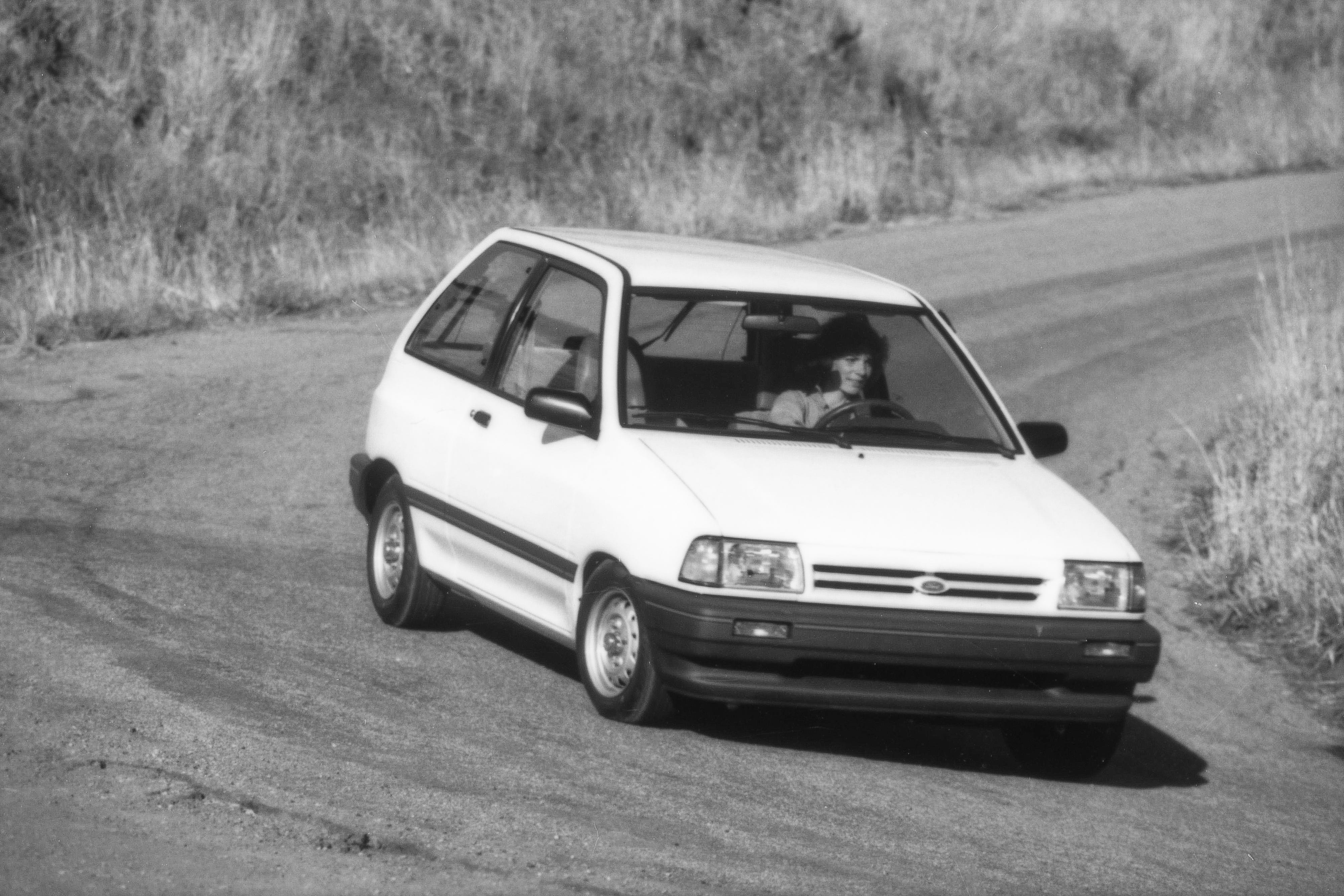
The 1987 Ford Festiva LX: A Budget Car With a Surprisingly Big Story
At first glance, the 1987 Ford Festiva LX looks like exactly what it was marketed to be: a no-frills, fuel-sipping econobox aimed at first-time buyers, commuters, and budget-conscious drivers navigating the tail end of the Reagan era. But look a little closer — or dig into its development history — and you'll find one of the most fascinating cross-continental automotive collaborations of the 1980s. This was the perfect car for yuppies-in-training, and it wore that badge with surprising competence.
A Lineage That Spans Three Continents
The story of the Ford Festiva begins not in Detroit, but in a web of international partnerships that defined much of Ford's global strategy in the 1970s and 1980s. The Festiva was designed by Ghia, Ford's Italian design house based in Turin — the same studio responsible for some of Ford's most stylish concepts and production vehicles over the decades. That Italian influence gave the Festiva a cleaner, more cohesive aesthetic than many of its budget-segment rivals, despite its humble price tag.
Engineering responsibilities, however, fell to Mazda. Ford and Mazda had maintained a close working relationship since Ford acquired a minority stake in the Japanese automaker in 1979, and the Festiva's underpinnings drew heavily from Mazda's small-car expertise. The result was a mechanically sound, well-engineered platform that punched above its class in terms of reliability and driving dynamics.
And where was this Italian-designed, Japanese-engineered car actually built? South Korea. Specifically, it rolled off the assembly lines at Kia Motors, which was then still a relatively modest manufacturer with deep ties to Mazda's technology. The Festiva was also sold in South Korea as the Kia Pride, a model that would enjoy a remarkably long production run in various international markets well into the 1990s. For American buyers, none of this backstory was particularly visible — they just saw a Ford badge, a small sticker price, and a practical hatchback.
What Did the LX Trim Actually Offer?
The Festiva was offered in a handful of trim levels when it launched for the 1988 model year in the United States (with some sources noting 1987 production examples entering the market). The base model was intentionally spartan, but the LX trim represented the sweet spot for buyers who wanted a bit more refinement without abandoning the car's core value proposition.
Under the hood, all 1987–88 Festivas used a 1.3-liter four-cylinder engine producing around 58 horsepower — modest even by the standards of the day, but entirely adequate for urban commuting and highway cruising at sensible speeds. Paired with either a five-speed manual or three-speed automatic transmission, the Festiva returned impressive fuel economy figures that made it an attractive option at a time when American buyers were still acutely aware of gas prices.
The LX added features that base-model buyers had to do without, including:
- Body-colored bumpers that gave the car a more polished appearance
- A rear window wiper and defroster for improved all-weather visibility
- Upgraded interior trim and improved seating materials
- A better sound system than the stripped base specification
- Tinted glass as standard equipment
None of this was luxurious by any stretch, but in the context of a car that sold for well under $7,000, the LX trim made the Festiva feel reasonably complete rather than aggressively cheap.
Driving the Festiva: Small Car, Real Character
Critics who expected the Festiva to drive like a motorized shopping cart were often pleasantly surprised. The Ghia-designed body kept weight to a minimum — curb weight hovered around 1,700 pounds — which meant the modest 1.3-liter engine felt considerably more capable than its output figures suggested. The car was genuinely nimble in city traffic, with light steering and a tight turning radius that made urban parking a non-issue.
On the highway, the Festiva was less impressive, as sustained high-speed cruising exposed the limits of the engine's breathing. But for the buyer demographic the car was targeting — young professionals, urban commuters, and secondary-car seekers — those limitations were rarely encountered in day-to-day use. The five-speed manual, in particular, gave the car a sporty edge that made it more engaging to drive than many of its econobox contemporaries.
The Festiva's Place in 1980s Car Culture
The late 1980s were a fascinating period for the American small-car market. Japanese imports had firmly established that economy cars didn't have to be miserable to own, and domestic automakers were scrambling to respond with credible alternatives. The Ford Festiva, for all its international DNA, was marketed as a domestic product and positioned as proof that Ford could compete in the subcompact segment on quality as well as price.
It largely succeeded. The Festiva sold respectably throughout its production run, which extended to 1993, and earned a reputation for reliability that was unusual for American-branded economy cars of the era. Its low purchase price and minimal maintenance costs made it a genuine value proposition, not just a compromise.
Why the 1987 Ford Festiva LX Still Matters Today
In the world of classic and collectible cars, the Festiva occupies an underappreciated niche. Surviving examples are increasingly rare, partly because their low value historically made them targets for hard use and neglect rather than preservation. But for enthusiasts who appreciate automotive history, the Festiva represents something genuinely interesting: a moment when Ford's global network of design and engineering partnerships produced a cohesive, competent, and honest little car.
The 1987 Ford Festiva LX was never going to turn heads or anchor a car collection as a prestige piece. But as an artifact of its era — a practical, well-considered econobox built from Italian design sensibility, Japanese engineering discipline, and Korean manufacturing efficiency — it tells a story about globalization, automotive partnership, and the democratization of reliable transportation that resonates long after the last one rolled off Kia's assembly line.
For the yuppies-in-training of 1987, it was the right car at the right moment. For historians and enthusiasts today, it's a small car with a surprisingly large story to tell.